

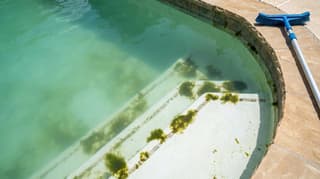
Here's how to get rid of algae in your pool: balance the pH to 7.2–7.4 so chlorine actually works, brush every surface, shock the water at a dose matched to your algae color, run the filter 24/7, then vacuum out the dead algae and deep-clean the filter. Skip any one step and the bloom usually comes back within days. We've been testing robotic pool cleaners on real pools since 2011 — including pools we've deliberately let go green to see how robots handle the cleanup — and this is the exact kill plan we use every time.
Key takeaways
- pH first: chlorine kills algae best at 7.2–7.4; at a pH of 8.0, most of its killing power is locked away.
- Dose by color: green algae needs a double shock, mustard a triple, black a quadruple.
- Brush or fail: algae hides under slime and waxy layers that block chlorine until you scrub them open.
- Dead algae doesn't remove itself: vacuum it out with fine filtration or it will cloud the water for weeks.
- Prevention is cheaper: steady sanitizer, daily circulation, and weekly robot cycles stop the next bloom before it starts.
First, identify the algae in your pool
Not every algae dies the same way, and thirty seconds of identification saves you from underdosing a stubborn strain and repeating the entire treatment.
| Algae type | What it looks like | Difficulty | Shock dose |
|---|---|---|---|
| Green | Cloudy green water, slimy walls and floor | Easiest, most common | Double (2x) |
| Mustard (yellow) | Dry yellow-brown dust clinging to shaded walls | Stubborn, chlorine-resistant | Triple (3x) |
| Black | Dark spots with deep roots, usually in plaster | Hardest, regrows from roots | Quadruple (4x) |
Green algae blooms fast — often over a single hot weekend after a chlorine lapse — but it also dies fast when you treat it correctly. Mustard algae looks like sand or pollen on shaded walls and steps, brushes off in a yellowish cloud, and shrugs off normal chlorine levels. It also hitchhikes on swimsuits, floats, and toys, so wash all of them in hot water while you treat. Black algae is the tank of the family: it anchors roots into plaster and concrete, protects itself with a waxy crust, and regrows from any fragment you leave alive. If you're not sure which strain you're fighting, treat for the tougher one — overdosing green algae costs a few extra dollars of shock, while underdosing mustard costs you the whole week.
Step 1: Test your water and pull pH down to 7.2–7.4
Chlorine's killing power depends heavily on pH. In the 7.2–7.4 range, most of your free chlorine exists in its active, algae-killing form. Let pH drift up to 8.0 and the majority of that power is chemically locked away — you can pour in shock all weekend and barely dent the bloom. Test first, then lower pH with muriatic acid or a dry acid product per the label.
While you're testing, check cyanuric acid (CYA). If your stabilizer reads above roughly 100 ppm, chlorine is so heavily buffered that shocking becomes an uphill fight, and a partial drain-and-refill may be the faster path. If you're unsure how to run a full test panel, our pool water testing guide walks through every number and the order to fix them.
Step 2: Brush every surface — before you shock
Brushing is the step everyone skips, and it's why so many treatments fail. Algae protects itself under a slime coating — and black algae under a waxy cap — that chlorine struggles to penetrate. Scrubbing breaks those defenses open so the shock can reach living cells.
Use a nylon brush on vinyl or fiberglass, and a stainless-steel brush on plaster, gunite, or concrete only. Hit the walls, floor, steps, waterline, behind ladders, and every shaded corner where mustard algae hides. For black algae, scrub each spot until the shiny protective head is broken — it should look raw and dull before you dose. And one pass isn't enough for mustard: brush its favorite shaded spots every day of the treatment, even after they look clean.
Step 3: Shock the pool, dosed by algae color
A standard shock dose is about one pound of granular shock (or the equivalent in liquid chlorine) per 10,000 gallons of water. For an active bloom, multiply it:
- Green algae: double dose (2x).
- Mustard algae: triple dose (3x), and toss brushes, floats, and cleaning gear into the shallow end so the treated water sanitizes them too.
- Black algae: quadruple dose (4x), with repeat treatments over the following week.
Two safety notes we repeat constantly. Never mix different chlorine products — cal-hypo and trichlor react violently in the same bucket, so dose one product at a time and rinse everything between uses. And follow your product's label on dissolving: most granular shocks should be pre-dissolved or broadcast across the deep end, never dumped through the skimmer.
Shock at dusk, with the pump running, so sunlight doesn't burn off the chlorine before it can work. And pull your robotic cleaner out of the water first — super-chlorinated water is hard on plastics and seals, and we cover the safe timing in can you run a pool robot while shocking.
Step 4: Run the filter 24/7 and brush again daily
Now the filter does the heavy lifting. Run it around the clock until the water clears — not on its usual 8-hour schedule. Within a day the water should shift from green to a cloudy gray-white. That's a good sign: gray means dead.
Each day until it's clear, brush the entire pool again to expose any survivors, retest chlorine, and re-dose if the level has collapsed. Backwash or rinse the filter whenever the pressure gauge climbs 8–10 psi above its clean baseline, because a bloom will load it quickly. A cloudy-gray day two is normal and encouraging; water that's still genuinely green on day three means re-shock at full strength — don't taper.
Step 5: Vacuum the dead algae out of your pool
Dead algae settles as a fine gray dust, and this is where most DIY treatments stall — the particles are too fine for coarse filter baskets, so they get stirred up and recirculated instead of removed. You have two good options. Manual vacuuming to waste sends everything out of the pool instantly but throws away hundreds of gallons of water. Or run a robotic cleaner fitted with ultra-fine filtration, which traps the dust down to the micron range while the water stays put.
This is the job robots built for dead algae exist for. Any of our picks with ultra-fine filter media will pull that gray haze off the floor in a cycle or two — and keep working walls and the waterline where residue lingers.
Our post-bloom routine looks like this:
- Run a full floor-and-walls cycle with the fine media installed.
- Rinse the filters as soon as the robot surfaces — dead algae clogs fine media fast.
- Repeat daily until the media comes back nearly clean, usually two or three cycles.
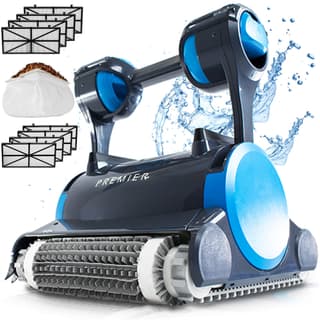
Dolphin Premier
$1999.00 $2499.00 Save 20%
Multi-Media filtration lets you swap to fine cartridges or optional NanoFilters for dead-algae dust, then back to the oversized leaf bag for everyday debris. Our first pick for post-bloom cleanup.
View Details → Free shipping · 30-day returns
Step 6: Deep-clean the filter, retest, and rebalance
Your filter just ate an entire bloom, and a quick rinse won't cut it. Backwash sand and DE filters thoroughly, and give cartridges a chemical filter-cleaner soak — dead algae and oils embed in the pleats and choke flow if you skip this.
Then retest everything. Bring free chlorine back into the 1–3 ppm range, pH to 7.2–7.6, and confirm alkalinity is holding. If you shocked with dichlor, recheck your stabilizer too — every dose of stabilized shock raises CYA a little, and it adds up over a long treatment. If the water is algae-free but still hazy, that's leftover fine debris — our guide to fixing cloudy pool water covers the final polish. Swim only once the water is clear and chlorine is back in the normal range.
Why algae keeps coming back to the same pool
If you've treated the same pool twice in a season, the bloom isn't bad luck — something structural is feeding it. Four causes account for nearly all repeat offenders.
Stabilizer drift. Cyanuric acid protects chlorine from sunlight, but too much of it locks chlorine up so tightly that your test reads fine while your pool is effectively under-sanitized. If your free chlorine looks adequate and algae still returns, test CYA — this is the single most missed cause of recurring blooms.
Phosphates from organic debris. Leaves, pollen, and lawn runoff feed phosphates into the water, and phosphates are algae fertilizer. This is where a robot that removes debris before it decomposes does more for prevention than any chemical does.
Dead spots in circulation. Steps, behind ladders, tanning ledges, and the wall-to-floor crease all get less flow than the open water. Treated water never fully reaches them, so a colony survives every treatment and reseeds the pool.
A filter that never got deep-cleaned. Algae hides in filter media. Shocking the pool without deep-cleaning the filter afterwards leaves a reservoir of live spores that goes straight back into the water on the next pump cycle — which is why that step is in the treatment sequence above, not optional.
How to keep algae from coming back
Every bloom we've ever diagnosed traces back to the same three gaps: sanitizer lapses, weak circulation, or surfaces that never get scrubbed. Close all three and algae has nowhere to start:
- Keep chlorine consistent — test two to three times a week in season instead of waiting for trouble.
- Run the pump 8–12 hours a day in summer so treated water reaches every corner.
- Run your robot on a schedule — two to three cycles a week brushes surfaces and removes the organic debris algae feeds on. Our best robots for algae removal roundup ranks the models we trust for algae-prone pools.
- Skim and empty baskets weekly. Leaves and organic debris are algae food — the less that rots in the water, the less chlorine you burn.
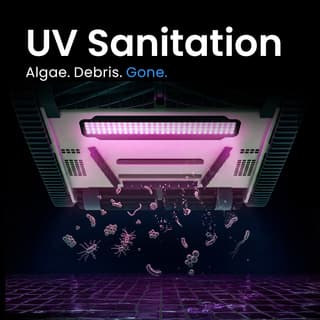
- Add UV to your cleanup crew. A UV robotic cleaner neutralizes algae spores and bacteria in the water it processes, which lowers the load on your chlorine between doses.
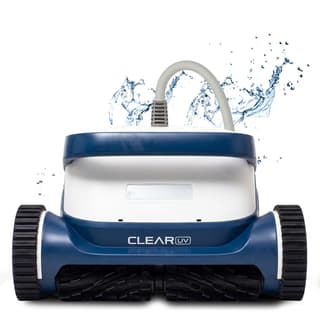
Clear UV
$1999.00 $2999.00 Save 33%
An onboard UV-C chamber neutralizes algae and bacteria as it cleans, while 1-micron UltraFilter media captures the fine particles blooms feed on. The robot we recommend to owners fighting recurring algae.
View Details → Free shipping · 30-day returns
A simple weekly rhythm — test, brush, robot cycle, empty baskets — takes under half an hour. Our maintenance guide lays out the full schedule.
Your next step
The bottom line
Getting rid of algae is a sequence, not a product: drop pH, brush every surface, shock at the dose the color demands, filter around the clock, brush again daily, then vacuum out the dead algae with fine media and deep-clean the filter. Skip the brushing and the shock can't reach the biofilm. Skip the filter clean and you reseed the pool. Do all six in order and even a green pool comes back inside a week.
If algae keeps winning, your pool needs a cleanup crew that shows up on schedule. Take our 60-second Help Me Choose quiz and we'll match a robot to your pool's size, surface, and debris — or browse every model we rate for algae-prone pools. Free shipping, 30-day returns, and full manufacturer warranties on everything we sell.
