

Do robotic pool cleaners pick up algae? Honest answer: partly — and the part they do, they do brilliantly. A good robot will scrub algae film off your floor and walls and, with fine enough filtration, vacuum up dead algae better than any manual method we've found. What a robot will not do is kill algae — that job belongs to your water chemistry. We've hand-tested 70+ robots on real pools since 2011, including some memorably green ones, so here's exactly what a pool robot contributes to an algae fight, where it falls short, and the shock-first sequence that actually works.
Key takeaways
- Robots remove, chemistry kills: a robot scrubs and vacuums algae, but only sanitizer kills it.
- Brushing is a real weapon: breaking up biofilm exposes algae so chlorine can finish the job.
- Filter fineness decides success: dead algae blows through standard baskets — use fine or 1-micron media.
- Sequence matters: shock kills the bloom first, then the robot vacuums the fallout.
- UV-C robots add prevention: the Clear UV neutralizes algae spores while it cleans.
What robotic pool cleaners can and can't do about algae
A robotic pool cleaner is a mechanical tool: it brushes surfaces, vacuums debris, and filters water. Algae is a living organism that regrows from microscopic spores. Keep those two facts in mind and the honest answer splits cleanly in two.
What robots do well:
- Scrub live algae off surfaces. Rotating brushes shear green film off floors, walls, and the waterline — the same work you'd do with a pool brush, done for hours without complaint.
- Vacuum dead algae. After a shock treatment kills a bloom, the dead algae settles as a fine gray-brown dust. A robot with ultra-fine filtration removes it in a pass or two.
- Move water. Every cycle circulates and filters water through corners and dead zones your pump's return jets barely touch.
What robots can't do:
- Kill algae. No amount of scrubbing destroys the spores suspended in the water column.
- Fix bad chemistry. If chlorine is low or pH is off, algae grows back as fast as the robot removes it.
- Clear a green pool alone. Green water is a chemistry emergency first and a cleaning job second.
If your pool has already turned, start with our full guide to getting rid of algae, then come back here for the cleanup phase.

Robots don't kill algae — chlorine does
Algae blooms when your sanitizer loses the arms race: free chlorine drifts low, pH creeps high enough to weaken the chlorine you do have, warm water accelerates growth, and phosphates from leaves and dirt feed the whole party. A robot has no answer for any of that. Drop one into a pool with active growth and unbalanced water and you'll get a clean-looking pool for about a day — then the green comes back, because the cause never left.
Our house rule after fifteen summers of doing this: balance the water before you blame the robot. Test first, hold free chlorine in the normal sanitized range, keep pH in the mid-7s, and the robot's brushing and filtering suddenly look twice as effective — because now nothing is growing back behind it.
One nuance worth knowing: not all algae fights the same. Common green algae surrenders quickly to shock plus brushing. Mustard algae — the yellowish dust that clings to shaded walls — resists chlorine and re-blooms unless you treat, brush, and vacuum thoroughly, so fine filtration matters even more. Black algae anchors roots into plaster, and while a robot's constant brushing helps keep it from re-establishing after treatment, the kill itself demands aggressive, persistent chemistry. In every case the division of labor holds: chemistry executes, the robot demolishes the wreckage and hauls it away.
Three ways a robot genuinely helps you beat algae
Once chemistry is doing the killing, a robot becomes a legitimate weapon in the fight. Three reasons why:
- Brushing breaks the biofilm. Algae anchors itself inside a slimy biofilm layer that chlorine struggles to penetrate. Brushes tear that layer open so sanitizer reaches the live cells underneath. There's a reason "brush the entire pool" appears on every algae-treatment checklist — a robot simply does it automatically, every cycle. That's the core case for the robots we recommend for algae-prone pools.
- Circulation denies algae its favorite real estate. Blooms almost always start in dead spots — steps, corners, behind ladders — where water sits still and sanitizer runs thin. A robot physically stirs those zones on every pass.
- It removes the food and the fallout. Leaves, dust, and dirt carry phosphates, which are fertilizer for algae. Every filter basket you empty is nutrients leaving the pool. And after a kill, vacuuming out the dead algae keeps it from clouding the water or feeding the next bloom.
The right sequence: shock kills, then the robot cleans up
When algae takes hold, order of operations decides whether you win in three days or fight for three weeks. Here's the sequence we walk customers through:
- Test and balance. Get pH toward the low end of normal so your shock works at full strength.
- Run a quick robot cycle, then pull the robot out. Removing leaves and debris first means the shock attacks algae instead of burning itself up on organic junk.
- Shock at dusk. Sunlight degrades chlorine, so an evening dose works all night at full power.
- Circulate overnight with the pump — not the robot — so the shock reaches every corner.
- Retest the next day. Once chlorine falls back below about 5 ppm, send the robot in with your finest filter media to vacuum the dead algae off the floor.
- Rinse filters and repeat cycles until the floor stays clean between runs.
Why keep the robot out during the shock itself? Concentrated oxidizer is hard on seals and plastics, and stirred-up granules can bleach surfaces — we cover the details in can you run a pool robot while shocking?. For step 5, the robots built for dead-algae cleanup earn their keep.
Filter fineness decides whether your robot picks up dead algae
Here's where most "my robot doesn't pick up algae" complaints actually come from. Dead algae particles are extremely small — far smaller than a leaf basket's mesh. Run a coarse basket over a dusted floor and the robot inhales the algae, blows much of it out the top, and re-settles it behind the unit. The robot isn't broken; it's wearing the wrong filter.
| Filter media | What it reliably catches | When to use it |
|---|---|---|
| Standard basket / leaf bag | Leaves, twigs, acorns | Everyday duty, fall cleanup |
| Fine cartridges | Sand, everyday dirt, silt | General cleaning |
| NanoFilters (ultra-fine) | Pollen, fine silt, dead algae | Post-shock cleanup, pollen season |
| UltraFilter 1-micron | The finest suspended particles | Algae recovery, water polishing |
If algae is a recurring visitor, choose a robot that accepts ultra-fine filter media — or add NanoFilters to a compatible Dolphin. In our testing, the difference on a post-shock floor is night and day: ultra-fine media picks it up in one pass and holds it.
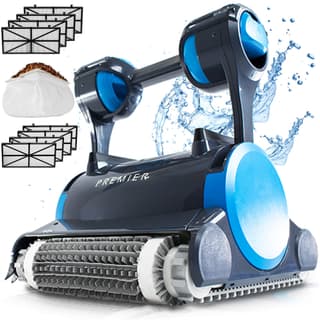
Dolphin Premier
$1999.00 $2499.00 Save 20%
Multi-media filtration lets you swap in ultra-fine NanoFilters for post-shock cleanup, then switch back to the oversized leaf bag for everyday debris. Dual commercial-grade motors and a 3-year warranty.
View Details → Free shipping · 30-day returns
UV-C robots: cleanup plus prevention in one machine
There's now a robot that gets closer to the "kills algae" side of the ledger than anything else we've tested. The Clear UV pairs conventional scrubbing and vacuuming with an onboard UV-C sanitation chamber: as water passes through the robot, ultraviolet light neutralizes bacteria and algae spores before the water returns to the pool. Add its 1-micron UltraFilter media and you get a machine that removes the particles and knocks down the biology in one cycle.
To be clear, it's not a replacement for chlorine — nothing is. But by lowering the biological load every time it runs, it helps your sanitizer stay ahead instead of playing catch-up, which is exactly what algae-prone pools need. Read more about UV robotic pool cleaners, how the technology works in our UV pool sanitizer explainer, or browse the full Clear series.
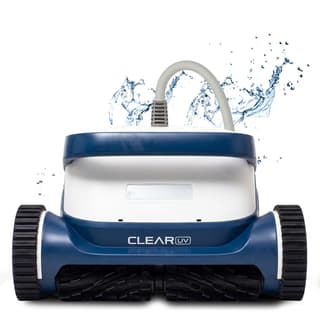
Clear UV
$1999.00 $2999.00 Save 33%
The only robot we sell that fights algae on two fronts — a UV-C chamber neutralizes spores as it cleans, while 1-micron UltraFilter media captures particles standard filters miss.
View Details → Free shipping · 30-day returns
The four places algae starts, and why brushing beats chemistry there
Algae almost never blooms evenly across a pool. It establishes in the four spots where circulation is weakest and light is plentiful, then spreads. Knowing them turns a vague weekly brush into a two-minute targeted job.
- The shallow-end steps and swim-outs. Warm, bright, and barely reached by return flow. This is where the first green film almost always appears.
- Behind the ladder and around fittings. Shadowed, sheltered from flow, and rarely brushed because it's awkward.
- The wall-to-floor crease. Debris settles here and forms a nutrient bed; circulation runs parallel to it rather than through it.
- Any rough or porous surface. Plaster that's lost its polish, pebble finishes, and tile grout all give algae the microscopic texture it needs to grip. A gunite or plaster pool needs more brushing attention than a smooth vinyl one for exactly this reason.
The reason brushing matters more than another dose of chemicals in these spots is mechanical: mature algae builds a biofilm layer that chlorine has to penetrate before it can kill anything. Breaking that film open is a physical job. It's also precisely what a robot's brushes do on every cycle — which is why frequent robot runs prevent blooms that no amount of reactive shocking will stop from recurring.
Our verdict
Robotic pool cleaners don't pick up living algae — they pick up dead algae, and they prevent live algae from ever getting established. That's a better deal than it sounds. Let chlorine do the killing, let the robot's brushes stop biofilm from maturing in the first place, and load ultra-fine media before the post-shock cleanup run. Skip the fine media and you'll simply redistribute the problem.
Next step: pick the right robot for an algae-prone pool
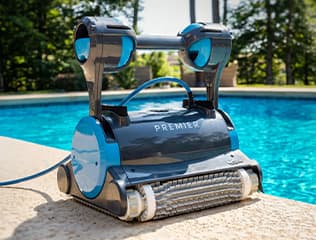
If you want the short version of everything above: keep your chemistry balanced, run the robot frequently so biofilm never matures, use ultra-fine media when algae dies, and let shock do the killing. For hardware, the Dolphin Premier is our post-shock cleanup pick thanks to its swappable media, and the Clear UV is the one to own if prevention is the goal — see how they stack up against the field in our best robots for algae removal rankings.
Not sure which fits your pool? Take the 60-second Help Me Choose quiz and we'll match a robot to your pool type, surface, and debris. Every robot ships free with 30-day returns and a full manufacturer warranty.
