

Can you run a pool robot while shocking the pool? Technically yes — nothing dramatic happens the moment shock hits the water. But we recommend you don't. After selling and servicing robotic cleaners since 2011, our standing advice is simple: pull the robot before you shock, and keep it out until free chlorine drops back below about 5 ppm. Two reasons. Concentrated shock is harsh on seals, plastics, and cable jackets over time, and a robot driving through undissolved granules can drag liner-bleaching concentrations across your pool floor. Here's the reasoning, the exceptions, and the exact sequence we use for algae recovery.
Key takeaways
- Short answer: wait until free chlorine falls below about 5 ppm before the robot goes back in.
- Why it matters: repeated exposure to shock-level chlorine ages seals, plastics, and cable jackets prematurely.
- Vinyl warning: a robot can trap undissolved granules against the liner and bleach it.
- The right order: shock at dusk, circulate with the pump overnight, robot the next day.
- The exception: light maintenance-level shocking is far gentler than a curative green-pool dose.
The short answer: wait until chlorine drops below about 5 ppm
A normally sanitized pool sits in the low single digits of free chlorine. A shock treatment deliberately pushes that many times higher — well into the double digits for a curative dose — to oxidize algae, bacteria, and contaminants in one overwhelming strike.
Robotic pool cleaners are engineered for the first environment, not the second. Sealed motors, o-rings, gaskets, impeller housings, and cable insulation all live happily in normal chlorinated or saltwater pools for years. Shock-level water is a different chemical environment: a strong oxidizer bath that attacks rubber and plastic compounds far faster than everyday water ever will.
So the rule we give every customer is the one we follow ourselves — test the water, and put the robot back in once free chlorine reads below about 5 ppm. With the pump running, most pools get there within a day or two of a standard shock. Strip tests are cheap; guessing isn't. And if a strip still shows the top of the color scale the next evening, resist the urge — a second night with just the pump running costs you nothing.
One clarification, since people ask: this isn't about electricity. Robotic cleaners run on low voltage from their external power supply, which is why they're safe to operate in water in the first place. The concern during a shock treatment is purely chemical — what a strong oxidizer does to rubber and plastic with repeated exposure, and what concentrated granules can do to your pool's finish.
Why we pull the robot while shocking the pool
One swim through shocked water won't kill a robot. The problem is that pool habits repeat all season, every season. Shock weekly with the robot sitting on the floor and you've multiplied its lifetime chemical exposure many times over — and the failure points are exactly the parts oxidizers love: motor shaft seals, o-rings, the flexible cable jacket, and the plastic housings that keep water out of the electronics.
The robots that come back to our service bench with brittle, cracked cable jackets and weeping seals are disproportionately the ones that lived in harsh water — left in the pool around the clock, through shock treatments and all. The ones that get pulled, rinsed, and stored in the shade routinely reach the far end of the 5-8 year lifespan these machines are capable of.
A robot is a four-figure investment. Keeping it out of the pool for a day while chemistry does its work is the cheapest life-extension program there is.
The undissolved granule problem (especially for vinyl)
There's a second, faster danger that has nothing to do with slow seal wear. Granular shock — cal-hypo in particular — doesn't always dissolve on the way down. Undissolved granules settle on the floor as little piles of extremely concentrated chlorine, which is why the label tells you to pre-dissolve or brush the floor afterward: left sitting, those piles can bleach and weaken a vinyl liner in one afternoon.
Now add a robot. Its tracks drive straight through the piles, its brushes smear them across the floor, and its flat underside can park concentrated granules against the liner while it climbs or pauses. On vinyl pools, that's how you get permanent pale patches in a robot-shaped trail. Fiberglass and plaster tolerate more, but bleached spots and etching are possible there too.
Shock type changes the risk level, too. Liquid chlorine disperses immediately and leaves nothing on the floor. Dichlor granules dissolve quickly and fairly completely. Cal-hypo — the most common bagged shock — is the slow dissolver that leaves gritty piles on the bottom, and it's the one that pairs worst with a robot in the water.
Whatever you use, pre-dissolve granular shock in a bucket of pool water per the product label, pour it around the perimeter at dusk, and let the pump handle the mixing. The robot has no business down there until everything is dissolved and levels have fallen.
The smart sequence for algae recovery
Shocking because the pool turned green? This is the order that gets you swimming fastest — it's the same sequence from our full guide to getting rid of pool algae:
- Run the robot first, then remove it. Vacuuming out leaves and debris before you shock means the chlorine spends itself on algae instead of organic junk.
- Balance pH toward the low-normal end so the shock works at full strength.
- Shock at dusk. Sunlight burns off chlorine; an evening dose works all night.
- Circulate overnight with the pump. The pump is immune to the chemistry and spreads the shock everywhere the algae hides.
- Test the next day. Below about 5 ppm, you're clear.
- Send the robot in with fine filters. Dead algae settles as fine dust, so run your finest media — this is where the dead-algae cleanup robots shine. Full details in do robotic pool cleaners pick up algae?
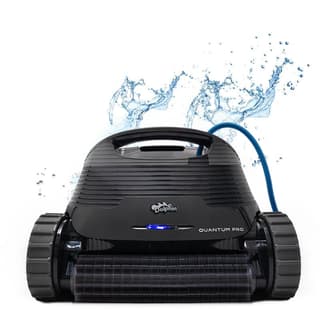
Dolphin Quantum
$1649.00
The XXL top-load fine basket swallows a whole floor of dead algae and debris, and it's NanoFilter-ready for the ultra-fine dust a shock leaves behind. Our value pick for recovery duty.
View Details → Free shipping · 30-day returns
When can the pool robot go back in? A chlorine cheat sheet
| Free chlorine reading | What it means | Robot in the pool? |
|---|---|---|
| 1-4 ppm | Normal sanitized range | Yes — run as usual |
| 5-9 ppm | Maintenance shock or high normal | Wait if you can; a brief cycle is low-risk |
| 10 ppm and up | Curative shock territory | No — keep the robot out until levels fall |
About that middle row: not all shocking is equal. A light weekly maintenance shock — a small oxidizer dose to burn off contaminants before problems start — raises chlorine modestly and briefly, and dissolved thoroughly it poses little threat. Running the robot the next morning after a maintenance dose is a reasonable call. A curative shock for a green or cloudy pool is the aggressive scenario this article is really about: high doses, sometimes repeated, often with granules on the floor. That's when the robot stays on its caddy, no exceptions.
What to do if the robot was already in there
It happens — you shocked on Friday evening and remembered the robot on Sunday. Don't panic, and don't assume damage. Do this instead.
- Pull it out and rinse it thoroughly with fresh water, inside and out. Pay attention to the filter housing, the brushes, and the point where the cable enters the body — that's where residue concentrates.
- Remove and rinse the filters separately. Shock residue trapped in media keeps working on it long after the robot is out of the pool.
- Dry it in the shade, not the sun. Heat plus oxidizer residue is the combination that hardens seals.
- Check the cable jacket for any chalky or stiff sections, and the brushes for discoloration. Both are early signs of chemical aging, and both are cheap to replace before they become a leak.
- Skip the next cycle if the water still tests above 5 ppm. Give the pump a night to bring it down first.
A single exposure very rarely kills a robot. It's the fifteenth one that does — which is exactly why the habit below matters more than any one weekend.
Protect your investment between cycles
This is a good moment for a habit we preach constantly: don't store your robot in the pool. A parked robot soaks in whatever chemistry the water is running — shock weekends included — and UV sunlight works on its plastics and cable from above. The robots we see age best follow the same routine: run the cycle, pull the robot, rinse it with fresh water, and park it on a caddy in the shade. The same habit protects the parts that never touch shock at all — the power supply stays dry, the cable coils loosely instead of baking in the sun, and the whole rig is ready to deploy the moment the water tests clean. Our maintenance guide covers the full care routine, and a proper robot caddy makes the habit effortless.
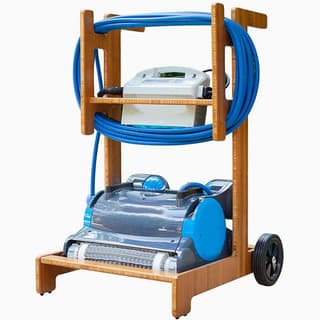
Terra Premium Caddy
$249.00
Waterproof storage for your robot and power supply with UV protection — the easiest way to keep your cleaner out of shock-level water and summer sun between cycles.
View Details → Free shipping · 30-day returns
Next step
The bottom line
You can run a pool robot while shocking. You shouldn't. Shock at dusk, let the pump circulate overnight, test in the morning, and send the robot in once free chlorine is back under about 5 ppm — where it will happily vacuum up the dead algae the shock just killed. One day of patience per treatment, multiplied across a season, is the difference between a robot that lasts three years and one that lasts eight.
The takeaway is one sentence long: shock the pool, run the pump, and give the robot a day off — then let it vacuum up the aftermath. Your water gets clean, your robot lives longer, and nobody bleaches a liner.
If your current cleaner struggles with post-shock fine debris, it may be time for better filtration. Take our 60-second Help Me Choose quiz to find the right match for your pool, or talk to our team — we've helped more than 10,000 pool owners get this right.
