

A UV pool sanitizer uses UV-C light — the same germicidal wavelength hospitals and water-treatment plants rely on — to damage the DNA of bacteria and algae so they can't reproduce. The technology is real and proven, and it's now built directly into robotic pool cleaners like the Clear UV. What it is not: a replacement for chlorine. We've tested 70+ robotic pool cleaners on real pools since 2011, and in this guide we'll explain how UV-C actually works, the difference between inline systems and UV robots, what UV genuinely improves, and whether the Clear UV deserves a spot in your pool.
Key takeaways
- How it works: UV-C light scrambles the DNA of bacteria and algae so they can't reproduce — no chemicals involved.
- A supplement, not a swap: UV leaves no residual protection in the water, so your pool still needs chlorine.
- Proven benefits: fewer algae blooms, less chloramine smell, and lower overall chemical demand.
- Two paths: inline systems require plumbing and installation; a UV robot drops in and sanitizes while it cleans.
- Our pick: the Clear UV pairs a UV-C chamber with 1-micron UltraFilter media and a 3-year warranty.
What is a UV pool sanitizer?
A UV pool sanitizer is any device that exposes pool water to concentrated UV-C light inside a sealed chamber. Water flows past the lamp, microorganisms in that water absorb a dose of germicidal light, and they come out the other side unable to reproduce. It comes in two forms: inline systems plumbed into your pool's circulation line, and — much newer — robotic pool cleaners with a UV-C chamber onboard, which treat water while they scrub and vacuum. You can see every model we carry in our UV robot collection.
The technology itself has a long pedigree. Municipal water plants, aquariums, and hospitals have used UV-C disinfection for decades because it kills microorganisms without adding anything to the water. It arrived in residential pools for a simple reason: it shores up chlorine's two weak spots — algae blooms and the chloramine buildup that causes that "pool smell."
How UV-C light kills bacteria and algae
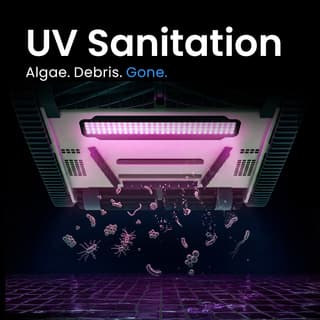
Sunlight contains a spectrum of ultraviolet light, and UV-C is the shortest, most energetic band — so energetic that Earth's atmosphere filters almost all of it out. When a bacterium, virus, or algae cell passes close to a UV-C lamp, that energy is absorbed by its DNA and RNA, physically scrambling the genetic instructions the organism needs to replicate. The microbe isn't vaporized; it's sterilized. And a microorganism that can't reproduce can't colonize your pool, so the population collapses instead of blooming.
Two details matter for setting expectations. First, UV-C only treats water that actually passes through the chamber — the dose depends on lamp intensity and contact time, which is why well-designed flow chambers matter more than marketing wattage. Second, the lamp is fully sealed inside the device. No UV light enters the pool itself, which is why swimmers are never exposed.
Inline UV systems vs. UV pool robots
Both approaches use the same physics; they differ in where the chamber lives and what else you get for your money.
| Factor | Inline UV system | UV robot (like the Clear UV) |
|---|---|---|
| Installation | Plumbed into the return line, usually by a pro | None — drop it in the pool |
| When it treats | Whenever the pump runs | During every cleaning cycle |
| Also cleans the pool? | No — sanitation only | Yes — scrubs floor, walls, and waterline |
| Filtration | Relies on your main filter | Onboard 1-micron UltraFilter |
| Total cost | Unit plus installation labor | One purchase, robot included |
An inline system treats more total gallons because it runs with your pump, and it's a fine choice for owners who want whole-circulation UV and don't mind the plumbing project. But for most homeowners — especially anyone already shopping for a robotic cleaner — the UV robot is the practical path: no installation, no plumbing, and the same purchase also handles the scrubbing, vacuuming, and fine filtration your pool needs anyway.
What a UV pool sanitizer does not replace
Here's the part some marketing glosses over, so we'll be blunt: a UV pool sanitizer does not eliminate the need for chlorine. UV kills only what passes through the chamber, and it leaves nothing behind in the water. Between passes, swimmers, rain, and wind are constantly reintroducing contaminants — and the only thing protecting the pool in that moment is a measurable free-chlorine residual dissolved in the water. That's chlorine's job, and health guidance for residential pools still calls for maintaining that residual, UV or not.
So the honest framing is this: UV reduces chlorine's workload; it doesn't take chlorine's job. If a product promises a chemical-free pool, walk away. Keep testing your water weekly and keep a proper residual — you'll simply find the water needs less correcting than it used to.
The real benefits: fewer blooms, less smell, lower demand
Once expectations are set correctly, the benefits are genuinely worth having.
- Fewer algae blooms. Algae spores ride in on wind, rain, and swimsuits, then wait for a warm week and a chlorine dip. Every pass through a UV-C chamber neutralizes spores before they can colonize a shady corner. Paired with a robot that physically scrubs surfaces — the other half of algae defense — it attacks the problem from both ends.
- Less of that "chlorine smell." Strong pool smell isn't chlorine working — it's chloramines, the compounds formed when chlorine binds with sweat, oils, and sunscreen. With UV shouldering part of the sanitizing load, chlorine is less overworked, chloramine levels stay lower, and the water is noticeably easier on eyes, skin, and noses.
- Lower chemical demand. With UV continuously knocking down the microorganism population, many owners hold free chlorine near the low end of the recommended range and reach for shock and clarifier far less often. Sun, heat, and bather load still set the rules — but the direction of travel is consistently down.
Who benefits most from UV sanitation
In our experience, UV makes the biggest difference for a few specific kinds of pool owners: households fighting recurring algae in warm climates or shaded corners; families with heavy swimmer loads — kids, pool parties, dogs — that spike chlorine demand; swimmers with sensitive skin and eyes who feel chloramines the most; and clarity perfectionists who want the pool people comment on. Long-season and year-round pools get the most total value, since the UV chamber is working every cleaning cycle, all year.
If none of that sounds like you and your water is already effortless, a standard robot with ultra-fine filtration may be all you need — we'll show you that option below.
Clear UV review: UV-C sanitation meets 1-micron filtration
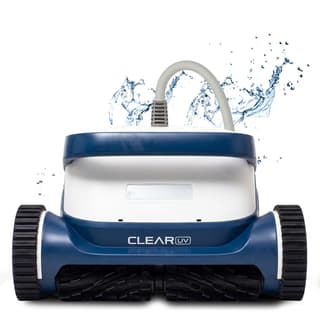
Clear UV
$1999.00 $2999.00 Save 33%
The first robot we've tested that meaningfully improves water quality while it cleans — a sealed UV-C chamber neutralizes bacteria and algae as the 1-micron UltraFilter polishes the water, with app control and a 3-year warranty.
View Details → Free shipping · 30-day returns
The Clear UV is the flagship of the new Clear series, and it's the robot that moved UV from "interesting" to "recommended" for us. As it drives the floor, walls, and waterline, it pumps water through an internal UV-C chamber and then through UltraFilter media that captures particles down to 1 micron — the ultra-fine filtration class that catches the silt and pollen standard cartridges let sail through. Sanitize the water, then polish it, on every single cycle.
In our test pool, the result is water that looks polished — the kind of sparkle owners usually chase with clarifier chemicals. App control handles scheduling and cleaning modes from your phone, and the 3-year warranty matches the best in the industry.
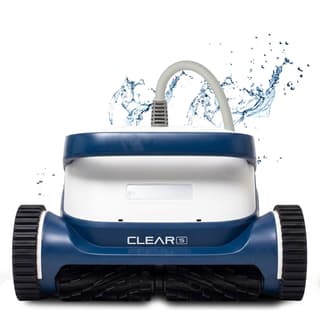
Clear S
$1749.00 $2749.00 Save 36%
Same excellent floor-to-waterline cleaning, app control, and ultra-fine filtration as the Clear UV — minus the UV-C chamber. The pick if you want a great smart robot and your water chemistry is already easy.
View Details → Free shipping · 30-day returns
If the UV chamber isn't a priority, the Clear S delivers the same coverage, app experience, and ultra-fine filtration for a couple hundred dollars less. Choose the Clear UV when water quality is the mission; choose the Clear S when you mainly want a great cleaner.
Our verdict
The Clear UV is the robot to buy when water quality is the whole point. It cleans like a flagship, and the UV-C chamber plus 1-micron UltraFilter deliver visibly clearer water with fewer chemical corrections. If you fight recurring algae, host heavy swim loads, or just want the clearest pool on the block, it earns its price — and if you only need a great cleaner, the Clear S saves you money.
Is a UV pool sanitizer right for your pool?
The bottom line
UV is a supplement, not a substitute. It kills what passes through the lamp and leaves nothing behind in the water, so you still need chlorine holding a residual everywhere the lamp isn't. What it genuinely buys you is a lower organic load — fewer chloramines, less of that "chlorine smell," and fewer blooms getting started. On a robot, that comes with no installation and no plumbing, which is what makes it worth considering at all.
If your pool battles algae, cloudiness, or heavy use — or you'd simply like your chlorine to work less hard — a UV robot is the easiest way to add UV-C sanitation, because there's nothing to install and the same machine cleans your pool. Browse our full UV robot lineup, or take the 60-second Help Me Choose quiz and we'll tell you honestly whether UV is worth it for your specific pool — we've helped more than 10,000 pool owners make exactly this call, and you can always ask our team directly. Every robot ships free with 30-day returns and a full manufacturer warranty.
