

Cloudy pool water is a particle problem: billions of suspended specks — dead organics, minerals, dust, oils — too small for your filter to catch, scattering light until the water looks milky. The fix depends entirely on which of seven causes put those particles there, and treating the wrong one wastes a week. We've been clearing test pools and customer pools since 2011, and diagnosis is nearly always faster than people expect: two water tests and two questions about your equipment narrow it to one or two culprits. Here's the full playbook.
Key takeaways
- Test before treating: chlorine and pH explain the majority of cloudy pools, and both tests take two minutes.
- Filtration is half the battle: short pump run times and coarse filter media keep haze suspended indefinitely.
- Particle size matters: standard filters miss the finest particles — 1-micron robot media catches what they can't.
- Clarifier gathers, floc sinks: clarifier is slow and easy, flocculant is fast but demands a vacuum-to-waste cleanup.
- Shock isn't a cure-all: it fixes organic clouding but can worsen calcium clouding.
Cloudy pool water diagnosis: find your cause fast
Start with a full water test, then match your symptoms below. If you don't have current numbers, our pool water testing guide covers what to test and the ranges to aim for.
| Symptom | Likely cause | Fix |
|---|---|---|
| Free chlorine at or near zero | 1. No sanitizer | Shock, then hold 1–3 ppm |
| pH above 7.8 or alkalinity off | 2. Chemistry drift | Adjust alkalinity, then pH |
| Hard fill water, scale on tile | 3. High calcium | Lower pH, partial refill |
| Clears overnight, clouds by evening | 4. Pump run time | Run 8–12 hours daily |
| Balanced water, endless fine haze | 5. Particles too fine | 1-micron filtration or clarifier |
| Dull green tinge, chlorine vanishing | 6. Early algae | Treat as a bloom now |
| Cloudy after parties or hot weekends | 7. Swimmer load | Shock and skim oils |
Multiple matches are common — a neglected pool usually has two or three of these going at once. Work them in the order listed and re-evaluate after each fix.
Cause 1: Low or no chlorine
The most common culprit. When free chlorine runs out, bacteria and organic debris multiply unchecked, and the water dulls before it ever turns green. If your test shows chlorine at or near zero, don't just rebalance — shock the pool to burn off the accumulated organics, then keep free chlorine in the 1–3 ppm range going forward. Cloudiness from a sanitizer lapse usually clears within a day or two of restored chlorine plus continuous filtration. Catch it at this stage and you've dodged a full algae treatment. One counterintuitive sign worth knowing: a strong chlorine smell usually means chloramines — spent chlorine bound to contaminants — not over-chlorination. It's another vote for shocking, which clears the smell and the haze together.
Cause 2: pH or alkalinity out of range
High pH is a quiet haze machine. Above roughly 7.8, chlorine loses much of its killing power and dissolved calcium starts falling out of solution as microscopic carbonate particles — visible as a milky cast. Total alkalinity out of range makes it worse by letting pH swing wildly.
Fix the pair in order: bring total alkalinity to 80–120 ppm first, since it acts as pH's shock absorber, then settle pH at 7.2–7.6. Chemistry-driven haze often clears within 24 hours of getting these two numbers right, no additives required.
Cause 3: High calcium hardness
If your fill water is hard — common across the Sun Belt and the Southwest — calcium creeps up every time you top off, because evaporation leaves every mineral behind. Past roughly 400 ppm, water can't hold all that calcium, especially when pH and temperature rise, and the excess clouds the water and scales your tile and equipment.
You can't remove calcium with a chemical. Keep pH toward the lower end of range to hold calcium in solution, switch from calcium-based shock to liquid chlorine, and when hardness climbs well past 400 ppm, dilute with a partial drain and refill from a softer source.
Cause 4: Weak filtration or short run times
Your filter only cleans water that passes through it. Running the pump four hours a day means most of your water sits untreated, and haze builds faster than it's removed — the classic "clear in the morning, cloudy by dinner" pattern. In swim season, run the pump 8–12 hours daily. The goal is turnover — pushing your pool's entire volume through the filter at least once a day. Most residential systems need six to eight hours to manage it, which is why a four-hour schedule quietly loses ground all summer.
Then check the filter itself: a mudded sand bed, a worn cartridge, or a pressure gauge stuck 8–10 psi above its clean baseline all mean reduced flow. Backwash or clean it, and fold filter checks into your weekly routine — our maintenance guide has the full schedule.
Cause 5: Particles too fine for your filter to catch
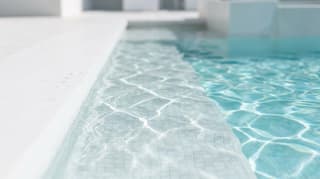
Here's the cause nobody diagnoses: your water can be perfectly balanced and your pump running all day, yet the haze never clears — because the particles are smaller than your filter's catch size. Standard sand filters trap down to roughly 20 microns and cartridges do somewhat better, but the fine silt, dust, and dead organics behind stubborn cloudiness run far smaller. For scale, a human hair is roughly 70 microns across — the particles scattering light in your water can be a tiny fraction of that. Your system just recirculates them, forever.
This is exactly where robotic cleaners with ultra-fine filtration change the game. UltraFilter media traps particles down to 1 micron, and NanoFilter media does the same for Dolphin robots — capturing in a couple of cycles what the main filter would never hold. In our testing, this is the single biggest jump from "clean" water to genuinely polished water. See every model we rank with this capability in our fine-filter robots roundup.
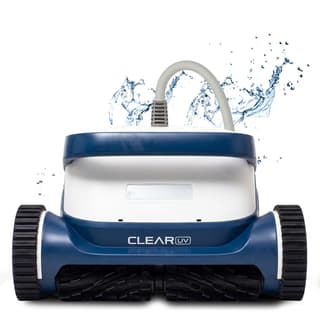
Clear UV
$1999.00 $2999.00 Save 33%
UltraFilter 1-micron filtration physically removes the fine haze standard filters recirculate, while the UV-C chamber neutralizes bacteria and algae as it cleans. The clearest water we've produced in testing.
View Details → Free shipping · 30-day returns
Causes 6 and 7: Early algae and heavy swimmer load
An algae bloom that hasn't turned green yet. Algae clouds water before it colors it. If your water looks dull with a faint green tinge and chlorine keeps vanishing faster than usual, you're catching a bloom in its opening act — chlorine demand spikes because it's fighting something alive. Treat it as algae today, while it's cheap and fast, rather than after it blooms; here's why pools turn green and how to respond at each stage.
Swimmer load, sunscreen, and organics. A big pool party leaves behind sunscreen, body oils, sweat, and cosmetics — a load of organic material that consumes chlorine and hangs in the water as an oily haze. The pattern is unmistakable: crystal clear Friday, cloudy Sunday night. Shock after heavy-use weekends, run the filter overnight, and skim the surface film where oils concentrate.
Clarifier vs. flocculant: the honest comparison
Pool stores hand out both for cloudy water, and they are not interchangeable:
- Clarifier is a coagulant: it clumps microscopic particles into filter-catchable sizes. It's cheap, low-effort, and slow — expect two or three days of continuous filtration. One warning from experience: follow the label dose, because overdosing clarifier acts as a dispersant and makes cloudiness worse.
- Flocculant binds everything into heavy clumps that sink to the floor overnight — dramatically faster, but the sediment must then be manually vacuumed to waste, bypassing the filter entirely. That requires a multiport valve, throws away real water, and isn't practical on most cartridge systems.
Quick rules of thumb: reach for clarifier when the water is hazy but you can still see the floor, reach for flocculant when you can't see the floor and you own a multiport valve, and reach for neither until chemistry and filtration are genuinely fixed — additives can't compensate for a broken foundation.
Our honest take: try the filtration-first path before either chemical. Fix chemistry, run the pump long hours, and put a robot with fine-dirt-grade filtration through daily cycles. Most cloudy pools clear in 24–72 hours this way, with nothing added to the water — and clarifier remains a fine assist for the stragglers.
How to prevent cloudy pool water for good
Every clear pool we service runs on the same rhythm: test chemistry two or three times a week, run the pump 8–12 hours in season, shock after storms and swim parties, keep the filter clean, and run fine-filtration robot cycles two or three times weekly so particles are removed before they accumulate. Owners who want extra insurance add UV — our explainer on UV pool sanitizers covers how UV robots reduce the organic load between chlorine doses.
The whole routine at a glance:
- Test chlorine and pH twice a week — two minutes.
- Run the pump 8–12 hours a day in season.
- Robot cycle with fine media two or three times a week.
- Shock after storms, parties, and heat waves.
- Rinse or backwash the filter when pressure climbs.
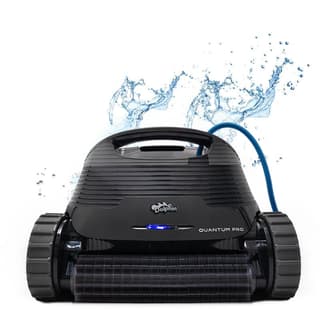
Dolphin Quantum
$1649.00
An XXL top-load basket with fine mesh — NanoFilter-ready for pollen and silt season — plus a weekly timer, so the water gets polished on schedule whether you remember or not.
View Details → Free shipping · 30-day returns
The bottom line
Cloudy water is almost never one problem — it's chemistry that drifted, then filtration that couldn't catch up. Test first and fix the chemistry, because no amount of filtering clears water that's still producing haze. Then give the pool run time and fine media, and be patient: most pools clear in 24 to 72 hours without a single bottle of clarifier. Reach for flocculant only when you need the pool clear by Saturday.
Ready to make cloudy water someone else's problem? Take our 60-second Help Me Choose quiz and we'll match a fine-filtration robot to your exact pool — free shipping, 30-day returns, and full manufacturer warranties included.
