

How do robotic pool cleaners work? In one sentence: a low-voltage power supply feeds a self-contained underwater robot that drives itself around the pool on software-guided paths, spinning brushes to loosen debris while a pump motor pulls it into an onboard filter — no hoses, no booster pump, no connection to your pool's plumbing. We've hand-tested more than 70 robots since 2011 and service what we sell, so we know these machines from the inside out. Here's the plain-English teardown of every major part, including the question we hear most often: how does it know where to go?
Key takeaways
- Self-contained by design: a robot carries its own drive motor, pump motor, brushes, and filter — your pool equipment isn't involved at all.
- Low voltage on purpose: the power supply steps household power down before it reaches the water, and runs on pennies per cycle.
- Navigation is real: gyroscope-equipped robots run systematic lanes, and good scanning software beats random bouncing every time.
- Filtration is the difference-maker: options run from oversized leaf bags to 1-micron media that visibly polishes water.
- Wall climbing is physics: suction grip plus tracked drive — no magic and no magnets.
How robotic pool cleaners work in 30 seconds
Here's the whole machine, step by step:
- Power. A transformer converts wall power to low voltage and sends it down a floating cable to the robot.
- Drive. A drive motor turns tracks or wheels while onboard software plots a coverage path around your pool.
- Scrub. Spinning brushes at the leading edge loosen algae film and stuck-on dirt just ahead of the intake.
- Vacuum and filter. A separate pump motor pulls water and debris up through an onboard filter, then jets clean water out the top.
- Climb. The same suction that filters the water presses the robot against the wall so it can climb and scrub the waterline.
- Finish. The cycle ends, you lift the robot out, rinse the filter for a minute, and the pool is clean.
Everything below is a closer look at those six steps — and at why the differences between robots matter more than the spec sheets suggest.
The power supply: low voltage on purpose
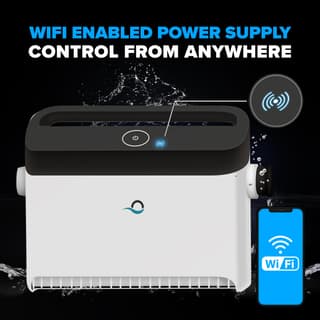
The box at the dry end of the cable is a transformer that steps 120-volt household power down to low-voltage DC before anything reaches the water — which is why a machine can safely run submerged for hours at a time. Plug it into a GFCI-protected outdoor outlet, keep it a few feet back from the water's edge and off the wet deck, and you're set.
The power supply is also the robot's control panel: start and stop, cleaning modes, and on many models the weekly timer that makes cleaning fully automatic. Even the cable is engineered — many corded robots use swivel cables that shed twists as the robot turns, which sounds minor and matters daily. The whole electrical system sips power: a full cleaning cycle costs about a nickel of electricity.
Two motors, two jobs: driving and pumping
Inside the shell, quality robots split the work between separate motors. The drive motor moves the robot and steers it by varying track speed side to side. The pump motor spins an impeller that pulls water in through intake ports on the underside and pushes it out the top — that continuous flow is what vacuums debris into the filter. Splitting the jobs means neither is compromised: full scrubbing traction and full suction at the same time, for the entire cycle.
Flagships push the same idea further — the Dolphin Premier runs dual commercial-grade motors, and the Sigma runs three. Sealed, brushless motor designs are a big part of why a well-cared-for robot survives 5–8 seasons in chemically treated water.
How does a robotic pool cleaner know where to go?
It scans. From the moment a robot hits the water, its software starts building a picture of your pool from sensor data: which way it's facing, how far it has traveled, when it meets a wall, when it climbs. Premium robots do this with a gyroscope — the same class of sensor that tells your phone which way is up — tracking orientation precisely enough to run systematic, overlapping lanes until the entire pool is covered, then re-planning when a ladder, drain, or step interrupts the route. That's why gyroscope-guided robots finish large and oddly shaped pools without missed patches.
Mid-range robots navigate with structured scanning software instead: no stored map, but pattern logic plus wall and angle detection that still reaches full coverage with a bit more overlap. What separates every true robot from bargain-bin machines is that robots plan their path — random-bounce cleaning relies on luck and a long runtime, and it shows in the missed corners.
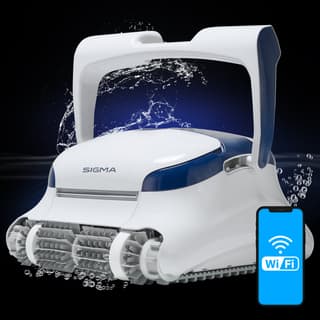
The Sigma is the strongest navigator we've tested — on big, complex pools, its methodical lanes are visibly different from mid-range scanning, and it's the robot we recommend when geometry is the challenge.
Dolphin Sigma
$2399.00 $2999.00 Save 20%
Gyroscope navigation, triple commercial-grade motors, and Wi-Fi app control — the robot that finishes large, complicated pools without missing a patch.
View Details → Free shipping · 30-day returns
Brushes: where the actual scrubbing happens
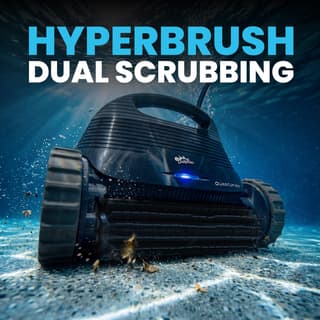
Suction alone won't lift algae film or the fine grime that bonds to pool surfaces — that's the brushes' job. Active brushes spin against the surface as the robot drives, breaking up biofilm and stuck-on dirt so the intake right behind them can capture it before it resettles. Different models use different brush styles for different finishes, from aggressive HyperBrush setups on above-ground robots to combined brushes that stay gentle on delicate surfaces.
The same scrubbing action is what works the waterline, where sunscreen and body oils collect into that familiar ring — a robot that scrubs it weekly is the difference between a line you never see and one you scrub by hand in July.
Onboard filtration: from leaf bags to 1-micron media
Everything the robot captures stays inside the robot, and what its filter can catch defines how clear your water looks afterward.
| Filter media | What it catches | Best for |
|---|---|---|
| Top-load basket, standard mesh | Leaves, twigs, hair, general dirt | Everyday cleaning, fastest emptying |
| Oversized leaf bag | Heavy leaf and acorn loads | Fall cleanup, pools under trees |
| Fine and ultra-fine cartridges | Sand, silt, algae particles | Most pools, most of the season |
| 1-micron media | Pollen, dead algae, fine dust | Water-polishing clarity |
Two notes from years of emptying these things. Top-load baskets are the everyday convenience winner — pop the hatch, dump, rinse, done. Oversized leaf bags swallow volumes of fall debris that would choke a basket, which is why the multi-media Premier, which swaps between both plus fine cartridges, is our best-overall pick. At the extreme end, 1-micron media captures pollen and dead algae standard cartridges miss — and the new Clear UV pairs that filtration with an onboard UV-C chamber that neutralizes bacteria and algae in the water passing through it.
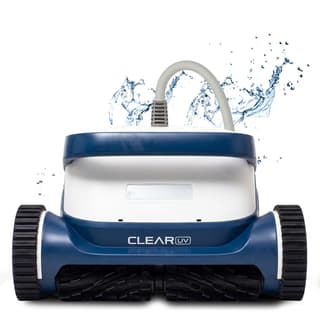
Clear UV
$1999.00 $2999.00 Save 33%
UltraFilter 1-micron filtration plus a UV-C sanitation chamber — it cleans the pool and actively improves the water while it works.
View Details → Free shipping · 30-day returns
How robots climb walls without falling off
No magnets, no glue — wall climbing is suction physics. The pump motor constantly pulls water through the robot's underside, and that intake flow presses the robot firmly against whatever surface it's on. On a vertical wall, the grip substitutes for gravity while the tracks — rubber or textured, chosen for wet traction — drive the robot upward. At the top, sensors detect the waterline (the motors need water, not air), so the robot pauses to scrub along the line, then releases and glides back down to continue the pattern.
Watch one do it and it looks like a party trick. Mechanically, it's the same wall-climbing system working the entire cycle — which is why wall performance is one of the clearest lines between a real robot and a cheap floor-wanderer.
Timers, Wi-Fi, and true hands-off cleaning
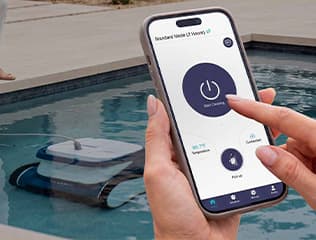
The mechanical parts clean your pool; the scheduling features are what make you forget you own it. Weekly timers re-run cycles automatically — set two or three per week and the pool simply stays clean without you thinking about it. Wi-Fi models add app control on top: start a cycle from the couch, choose modes, review history, even spot-steer the robot to a problem area.
One ownership habit matters more than any feature: don't store the robot in the pool between cycles. Constant chemical exposure ages seals and plastics faster than actual cleaning does. Lift it out, rinse the filter, keep it shaded — that's the difference between the robots that last eight seasons and the ones that don't.
What a robot can't do — and why that's by design
Understanding the mechanism also tells you where the limits are, which saves a lot of disappointment.
It doesn't sanitize. A robot removes what's in the water and scrubs what's on the surfaces. Killing bacteria and algae is chlorine's job, and no amount of vacuuming substitutes for balanced chemistry. The one partial exception is a UV-C model, which treats the water passing through it — helpful, but still not a replacement for sanitizer.
It doesn't skim the surface. Corded robots work below the waterline. Leaves that float for a day before sinking are a job for a surface skimmer or a net — or for one of the flagship cordless models that do skim.
It doesn't balance or circulate your pool. The robot's pump moves water through its own filter, not through your plumbing. Your main pump still has to run for heating, chemical distribution, and skimmer flow.
It doesn't clean what it can't reach. Steps, tight corners, and the tops of tanning ledges are geometry problems, not power problems. Most robots handle steps partially at best — budget five minutes a week with a brush for those, regardless of what you spend.
Put one to work in your pool
The bottom line
A robotic pool cleaner is a self-contained appliance that happens to work underwater: its own low-voltage supply, its own drive motor, its own pump, and its own filter. That independence from your pool's plumbing is the whole reason it cleans better than a suction cleaner while costing pennies to run — and the reason a good one keeps doing it for the better part of a decade.
Now that you know how they work, finding the right one is the easy part. Take our 60-second Help Me Choose quiz and we'll match a robot to your pool's type, size, surface, and debris — or browse our ranked best robotic pool cleaners. Every robot ships free with 30-day returns and a full manufacturer warranty.
