

An above-ground pool should take about 30–45 minutes of hands-on care per week: test the water twice, empty the skimmer basket, brush the waterline, and let a robotic cleaner cover the floor. That's the whole routine. The catch is that above-ground pool maintenance punishes neglect faster than inground care — less water volume means the chemistry swings harder and quicker. We've hand-tested 70+ robots since 2011, including on our own above-ground test pools, and this guide is the low-effort weekly system we recommend to the thousands of above-ground owners we've helped.
Key takeaways
- Small volume, fast swings: test twice a week — five minutes that prevents most problems.
- Vinyl is soft: nylon brushes and liner-safe tools only, and keep pH in range.
- Floor-only robots are the right tool: that's where the debris is, and it keeps the price under $700.
- 30–45 minutes weekly: with a robot on floor duty, that's the entire hands-on routine.
- Never fully drain: the water is what holds your walls and liner in shape.
What makes above-ground pool maintenance different
Same chemistry, same goals as any pool — different physics. Four things change:
Less water, faster swings. A 24-foot round holds roughly a third of the water of a typical inground pool, so the same rainstorm, heat wave, or pool party moves your numbers about three times as far. Twice-weekly testing isn't overkill; it's how you catch small drifts before they become green water or cloudy water.
A vinyl liner you must protect. The liner isn't just the finish — it's the waterproofing. It's soft, so the rule is nylon brushes only, never steel, and no abrasive pads. Chemistry protects it too: acidic water makes vinyl brittle, and overdosed chlorine bleaches it.
Walls under tension. Above-ground walls are thin steel or resin panels held rigid by water pressure. Don't hang heavy equipment off the top rail, and never drop the water below the recommended level.
Smaller filters. Most above-ground pools run compact cartridge systems that need a rinse every two to four weeks in season. It's a quick job — but skip it twice in a row and the water goes dull.
The low-effort weekly routine
| Task | How often | Hands-on time |
|---|---|---|
| Test water (chlorine + pH) | Twice a week | 5 min |
| Empty skimmer basket | Every 2–3 days | 2 min |
| Run the robotic cleaner | 2–3 times a week | 5 min |
| Brush waterline and steps | Weekly | 10 min |
| Shock | Weekly in season | 5 min |
| Rinse cartridge filter | Every 2–4 weeks | 15 min |
That's about 30–45 minutes of actual hands-on time in a normal week — the robot's cleaning cycles run while you do literally anything else. Glance at the pool daily on your way past: clear water, normal water level, skimmer moving. Thirty seconds of looking catches most problems days early.
Two timing tricks make the routine work even better. Run the robot the morning after storms or heavy swim days, when the debris load is at its worst — an above-ground pool's smaller volume means junk on the floor starts affecting chemistry sooner than it would in a big inground pool. And shock in the evening, after the sun is off the water, so the chlorine spends the night working instead of burning off.
If you're brand-new to water care, the fundamentals in our beginner's maintenance guide apply to above-ground pools exactly — just on the faster testing cadence above. Our maintenance hub has the season-by-season version.
Chemistry targets for above-ground pools
The target numbers are the same as any outdoor chlorine pool — you'll just visit them more often:
| Parameter | Target | Why it matters |
|---|---|---|
| Free chlorine | 1–3 ppm | Sanitizes; burns off faster in shallow, sun-heated water |
| pH | 7.4–7.6 | Comfort, chlorine efficiency, and liner protection |
| Total alkalinity | 80–120 ppm | Buffers pH against those fast small-pool swings |
| Stabilizer (CYA) | 30–50 ppm | Sunscreen for your chlorine — critical in full-sun pools |
Because above-ground pools are shallower and often sit in full sun, stabilizer matters more than most owners realize. Without it, UV can strip your chlorine in an afternoon and the pool spends every evening under-sanitized.
Liner-safe cleaning: protect the vinyl
A liner can last well over a decade treated well — or a few seasons treated badly. The rules are simple. Soft nylon brushes only, no wire brushes or scouring pads, and don't drag hard-edged equipment across the floor. Pre-dissolve granular shock in a bucket before adding it, so undissolved granules don't sit on the vinyl and bleach permanent light spots into it. Keep the water balanced so the water itself isn't the abrasive.
Watch for wrinkles, too. Liner wrinkles usually trace back to water chemistry (low pH makes vinyl relax and stretch) or a dropped water level, and they're much easier to prevent than to smooth out. Keep the level steady, keep the pH in range, and the liner stays drum-tight.
The same standard applies to your cleaner. Every robot we recommend for vinyl pools scrubs with brushes and rides on wheels or tracks designed to grip without scratching — aggressive on debris, gentle on the surface.
Why above-ground robots are floor-only (and that's fine)
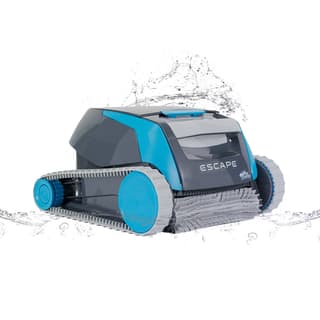
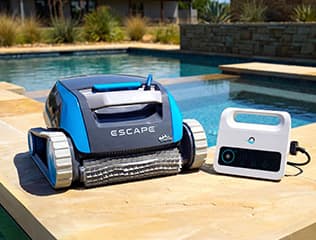
The Dolphin Escape — our above-ground pick for years — doesn't climb walls, and that's by design rather than corner-cutting. Above-ground walls are flexible vinyl over thin panels: not an ideal climbing surface. More importantly, gravity does the sorting for you. Virtually all debris in an above-ground pool ends up on the floor, which is exactly where a floor-focused robot spends 100% of its cycle. Skipping the wall-climbing hardware is also why a purpose-built above-ground robot costs hundreds less than an inground machine.
The one job left for you is the waterline ring — ten minutes with a soft brush once a week. Fair trade.
Dolphin Escape
$768.00 $899.00 Save 15%
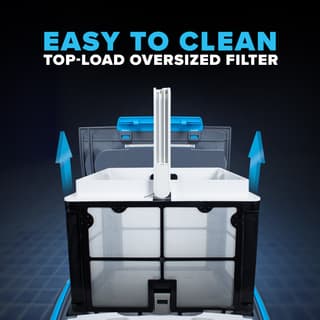
A commercial-grade motor, aggressive HyperBrush scrubbing, and a top-load basket that empties in seconds — purpose-built for above-ground pools up to 33 feet. No hoses, no booster pump, plugs into a standard outlet.
View Details → Free shipping · 30-day returns
In our 24-foot above-ground test pool, the Escape clears a full week of debris in a single cycle — it topped the above-ground category in our best robotic pool cleaners rankings again this year. You can browse every option in our above-ground collection.
Sizing: one robot covers pools up to 33 feet
Above-ground robots are sized generously. The Escape handles everything from 15-foot rounds to 18x33-foot ovals, which covers nearly every above-ground pool sold in the US. If you're at the small end, don't overthink it — a robot rated to 33 feet simply finishes a 15-foot pool faster. The practical thing to check is outlet placement: the robot plugs into a standard GFCI outlet, and its cable needs to reach the far side of the pool with slack to spare, so plan where the power supply will sit before the first run. And if you also maintain a small inground or semi-inground pool, a crossover model like the Dolphin Explorer E20 is built to handle both.
The budget path: a clean pool under $700
A purpose-built above-ground robot is one of the best values in pool care. The Escape lands comfortably in the under-$700 class — less than many owners spend on a season of professional cleanings, and far less than the years of hoses and wear parts a suction cleaner burns through. Want the price lower still? Open-box units are inspected, complete, and covered by our standard 30-day returns — the cheapest way into a best-budget robot that we fully stand behind.
Dolphin Escape (Open-Box)
$649.00 $899.00 Save 28%
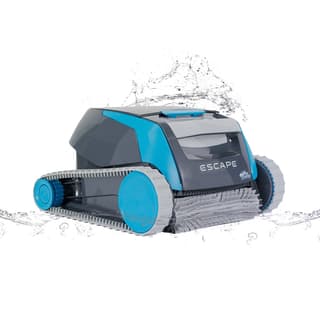
The same Escape — inspected, complete, and backed by our 30-day returns — at a genuine discount. The lowest-cost way to retire your manual vacuum for good.
View Details → Free shipping · 30-day returns
Three problems that hit above-ground pools hardest
Small volume is the common thread in almost every above-ground complaint we field. These are the three we see most, and the fix for each.
Cloudy water two days after a storm. Rain dilutes your chlorine and stabilizer, drops pH, and washes yard dust into a pool that has a third of the buffering volume of an inground. Test the morning after any real rain rather than waiting for the schedule, rebalance, and run the robot to pull the suspended dust the filter is too slow to catch. Our guide to cloudy pool water walks through the full diagnosis.
Algae along the ladder and the wall crease. Circulation in an above-ground pool is weakest where the wall meets the floor and behind the ladder — exactly where algae takes hold first. Brush both spots weekly whether or not you see anything, and aim your return jet slightly downward to keep water moving across the floor instead of spinning on the surface. If it's already green, the treatment sequence is in how to get rid of algae.
Grit that comes back every week. Fine sand and silt tracked in on feet settles into the floor's low spots and never quite leaves, because a cartridge filter passes particles that small straight through. This is where a robot with fine media earns its keep — it captures the grit rather than recirculating it. If it's genuinely reappearing after every clean, sand in the pool covers the less obvious source: a failing filter laterals.
Winterizing an above-ground pool: the basics
When the water drops below 60°F for good: balance the chemistry, add a winterizing kit, and lower the level just a few inches below the skimmer and return — never more. Never fully drain an above-ground pool. Water pressure is what supports the walls, and an empty liner shrinks and wrinkles in the cold. Install a winter cover with an air pillow underneath so ice and rain shed to the edges instead of stretching the cover, and bring the robot indoors — rinsed with fresh water, fully dried, cable coiled in loose loops. The complete walkthrough, robot storage included, is in our pool closing guide.
Your next step
The bottom line
Above-ground pools don't need more work than inground pools — they need faster work. Test twice a week instead of once, brush with nylon only, keep the water level where the walls want it, and hand the floor to a purpose-built robot. Do that and the entire routine fits in half an hour a week, most of which is standing next to the pool doing very little.
Above-ground care really is this simple: fast tests, gentle tools, and a robot on floor duty. If you want a personalized pick, take the 60-second Help Me Choose quiz and we'll match a robot to your exact pool size and debris — or ask our team directly. Every robot we sell ships free, with 30-day returns and a full manufacturer warranty.
