

Closing a pool well is the cheapest insurance in pool ownership. Here's how to close a pool in one line: deep-clean it, balance the water, add winterizing chemicals, protect the plumbing from freeze damage, store your equipment — robot included — the right way, and cover it tight. Do those steps in order and next spring's opening takes days, not weeks. We've been walking pool owners through fall closings since 2011 — 70+ robots hand-tested, more than 10,000 pool owners helped — and the robot-storage step is the one we see botched most often, so it gets its own section below.
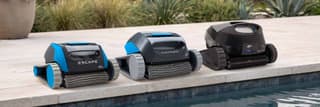
Key takeaways
- Close cold: wait until water holds below 60°F. Algae is dormant, so spring stays clean.
- Robot first: run a final deep-clean cycle before anything else — debris left behind stains surfaces and feeds spring algae.
- Know your climate: freeze zones blow out and plug the lines; mild zones can keep circulating instead.
- Store the robot right: rinse, dry, loose cable coils, indoors at 40–110°F — never under the cover.
- Label everything: plugs, fittings, and hardware in one labeled bin makes opening painless.
When should you close your pool?
Close when the water temperature drops below 60°F and stays there — typically late September through November depending on your region. Below 60°F, algae goes dormant, so the clean, balanced water you cover in late fall is roughly the water you'll uncover in spring. Close during a warm early fall and you seal active algae under a dark, insulating cover — the classic recipe for a green opening.
Don't push it too late in hard-freeze country, though: the plumbing needs to be blown out before the first serious freeze, not after. Watch the water temperature, not the calendar, and give yourself a free weekend once it dips.
Before you start, gather the supplies: a winterizing chemical kit, winter plugs and a skimmer guard, an air compressor or shop vac if you'll blow out lines yourself, your cover and its hardware, and one labeled bin for every plug and fitting you remove.
How to close a pool: 9 steps in order
- Give the pool a final deep clean. Skim, empty every basket, brush the walls, and run your robotic cleaner on a full cycle — two cycles if leaves have been falling. Organic debris left over winter stains surfaces and feeds spring algae, so this vacuum matters more than any July cleaning. Our leaf-season robot picks earn their keep this week.
- Test and balance the water. Alkalinity 80–120 ppm, pH 7.4–7.6, calcium hardness 200–400 ppm. Balanced water protects surfaces and equipment through the months when nobody's watching.
- Add winterizing chemicals. A closing kit — winter algaecide, shock, and usually a stain-and-scale preventer — added per the label with the pump running so everything circulates fully before shutdown.
- Clean the filter and baskets. Backwash sand or DE filters; deep-clean cartridges and store them dry indoors. A clean filter now means real filtration from hour one in spring.
- Lower the water level if your climate requires it. In freeze climates, drop a few inches below the skimmer or to your cover manufacturer's spec. In mild climates, leave it full.
- Blow out and plug the lines — freeze climates only. Push air through the skimmer, return, and cleaner lines until they bubble, then plug each one and protect the skimmer with a guard. This is the one step where hiring a pro is money well spent if you're unsure — cracked pipes are the most expensive closing mistake there is.
- Drain the equipment. Pull the drain plugs from the pump, filter, heater, and chlorinator, and stash every plug in the pump basket or your labeled bin so spring-you can find them.
- Remove accessories — and the robot. Ladders, rails, baskets, thermometers, and your robotic cleaner all come out. The robot never winters in the pool or under the cover; the next section covers its off-season properly.
- Cover it tight. Snug the safety cover anchors, or secure a winter cover with an air pillow underneath (essential for above-ground pools) and keep a cover pump handy for solid covers.
Freeze climates vs. mild climates
| Closing step | Hard-freeze winters | Mild winters |
|---|---|---|
| Water level | A few inches below the skimmer | Keep at normal level |
| Plumbing | Blow out and plug all lines | Leave open, use freeze protection |
| Circulation | Off until spring | Run the pump a few hours daily |
| Chemicals | Full winterizing kit | Lighter dosing, keep testing monthly |
| Cover | Solid or safety cover all season | Optional |
In mild-winter regions, "closing" is really "idling." Many owners keep the pump circulating a few hours a day, never fully cover, and simply test monthly — cold water holds chlorine well, but pH keeps drifting. Run that way and you can keep sending the robot down every week or two all winter; the same weekly fundamentals apply, just at a slower rhythm. Store the robot properly any time it won't be used for a few weeks.

How to winterize your robotic pool cleaner
This is the section our service techs wish every owner would read. The robots that reach us in spring with stiff cables and cracked housings almost all wintered in one of two places: under the pool cover, or hanging off a nail by a tightly wrapped cord in an unheated shed. Five minutes of proper storage prevents nearly all of it — and it's a big part of how long a robotic pool cleaner lasts.
- Run a last cycle, then pull the robot. After its final vacuum, take it out of the water — robots should never live in the pool, least of all through winter.
- Rinse the filters clean. Empty the basket or bag and hose the filter media until the water runs clear.
- Give the whole robot a fresh-water rinse. Never let pool water dry inside it — chlorine and salt residue quietly age seals and plastics.
- Dry it completely. Leave the filter compartment open until every surface is dry to the touch.
- Coil the cable in loose, wide loops. Never wrap it tightly around the power supply or your forearm — tight wraps set permanent kinks and stress the swivel. Big, lazy coils, laid flat.
- Store it indoors or fully shaded, between 40–110°F. A garage shelf, a basement corner, or a dedicated caddy — off the concrete, out of the sun, and never outside under the winter cover.
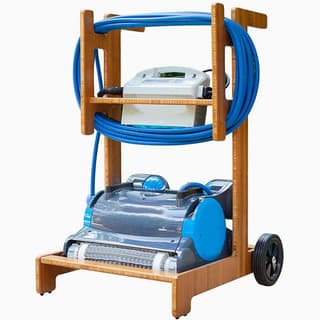
Terra Premium Caddy
$249.00
A waterproof, UV-protected home for your robot, cable, and power supply — everything stays coiled, organized, and off the garage floor until spring, then rolls back out to the pool in seconds.
View Details → Free shipping · 30-day returns
Common closing mistakes we see every fall
- Closing warm. Water above 60°F under a cover is an algae incubator. Wait for the cold.
- Skipping the final vacuum. Whatever you leave on the floor in October, you'll scrub off the floor in April — often as a stain.
- Overdraining. Water supports liners, walls, and covers; drop the level only as far as your climate and cover actually require.
- Leaving the robot in the pool or under the cover. Freeze stress, months of chemical soak, and cover chafe — the three fastest ways to shorten a robot's life.
- Tight-wrapping the cable. The most common preventable service issue we see, period. Loose loops only.
- No cover pump on a solid cover. A winter of rain and snowmelt pooling on top ends with the cover — and everything on it — in the pool.
A two-weekend closing timeline
Closing goes wrong when it's done in one rushed afternoon on the first cold day. Split it across two weekends and every step lands at the right water temperature.
Weekend one — while the water is still above 60°F. Deep-clean now, while chemistry still works properly and algae is still killable. Brush every surface, run the robot through two or three full cycles across the weekend, deep-clean your main filter, and balance the water fully. This is also the moment to order any replacement media so it's on the shelf for spring rather than back-ordered in April.
The gap. Let the water fall below 60°F for good. Keep skimming leaves off the surface — anything that sinks now is what stains the floor over winter. Resist covering early; a warm covered pool is the single most reliable way to open green.
Weekend two — once it's properly cold. Add winterizing chemicals, lower the water to the level your cover and climate require, blow out and plug the lines, fit the cover and cover pump, then winterize the robot last so it goes into storage clean and dry.
The order matters more than the calendar. Every mistake in the list above comes from doing a cold-weather step while the water is still warm, or a warm-weather step once it's too late to work.
The spring payoff
Every careful closing step pays out double in April. Cold, balanced, algaecide-protected water opens clear instead of green. Blown-out lines mean no surprise plumbing bills in February. A robot stored dry with a loose-coiled cable drops straight in for the first cleanup of the year. And if you stash a fresh set of filters with it now, opening-day water polish is one swap away — fine filtration is the difference between "clear" and "sparkling," and ultra-fine filter media does its best work on the silt an opening stirs up.
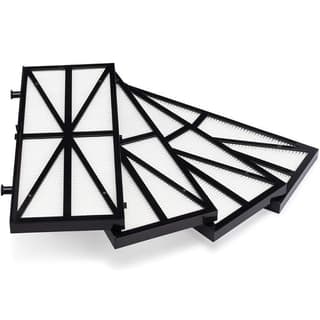
Dolphin NanoFilters
$109.00
Stash a fresh set of ultra-fine NanoFilters with your winterized robot and spring water polish is one swap away. Made for the Dolphin Premier, with variants available for most Dolphin models.
View Details → Free shipping · 30-day returns
When the water warms back up, just work the process in reverse with our pool opening checklist.
Your next step
The bottom line
Close cold, close clean, and close in the right order: deep-clean and balance while the water still cooperates, then winterize once it's reliably below 60°F. Never fully drain, never wrap the robot's cable tight, and never cover a warm pool. Do those five things and spring opening is a morning's work rather than a fortnight of chasing green water.
If closing season has you thinking about the rest of the pool calendar, our maintenance hub covers the whole year, season by season. And if your final vacuum of the year was a manual one, make it your last: take the 60-second Help Me Choose quiz and we'll match a robot to your pool before next season — free shipping, 30-day returns, full manufacturer warranties, and our team on call whenever you need us.
