

Here's how to vacuum a pool: attach the vacuum head to your pole and hose, prime the hose to push out the air, connect it to the skimmer's suction line with a vac plate, and make slow, overlapping passes across the floor — about 30-60 minutes for a typical pool. We've cleaned pools both ways for fifteen years — by hand, and with the 70+ robotic cleaners we've tested since 2011 — so this guide teaches the manual technique properly first, then makes the honest case for letting a machine take the job off your hands.

Key takeaways
- Slow passes are the whole game: rush and you stir fine debris into a cloud that takes hours to resettle.
- Prime the hose completely: trapped air is the number-one cause of lost suction.
- Vacuum to waste for algae and heavy silt so debris bypasses your filter entirely.
- Budget 30-60 minutes weekly for manual vacuuming — it's real exercise.
- A robot does the same job automatically, with finer filtration and zero load on your pump and filter.
What you need to vacuum a pool
Manual vacuuming runs on your pool's own pump. Five pieces of gear make it work:
- Telescopic pole — the same one your leaf net and brush clip onto.
- Vacuum head — a weighted, wheeled head suits concrete and gunite floors; a brush-bottom head is gentler on vinyl and fiberglass.
- Vacuum hose — long enough to reach the farthest corner of the pool from the skimmer with slack to spare.
- Skim-vac plate — sits on top of the skimmer basket so the hose connects without removing the basket, letting the basket catch big debris before it reaches your pump.
- A running pump and clean-enough filter — the vacuum is only as strong as the suction behind it, so empty the pump basket and check filter pressure before you start.
If you're starting from zero, the whole manual kit runs well under $200 — worth owning even if a robot ends up doing the weekly work, because nothing beats it for a quick spot-clean of one corner after a backyard party.
How to vacuum a pool step by step
The technique matters more than the gear. Done right, the water barely ripples; done wrong, you're chasing a silt cloud around the deep end.
- Assemble the rig. Clamp the vacuum head onto the pole and attach the swivel end of the hose to the head.
- Lower the head to the floor at the wall nearest the skimmer, letting the pole lean against the coping.
- Prime the hose. Feed the hose straight down into the water hand over hand, or hold the free end against a return jet, until bubbles stop rising from the vacuum head. A hose full of air will kill your pump's prime the moment you connect it.
- Connect at the skimmer. Keeping the hose end underwater, seat the vac plate over the skimmer basket and plug the hose into it. You should feel suction grab immediately and see the hose stiffen.
- Vacuum in slow, overlapping passes. Work the floor like you'd mow a lawn — straight lanes, each pass overlapping the last by half a head-width, moving about one foot per second. If you kick up a cloud, stop and let it settle before continuing.
- Check mid-job. On a dirty pool, pause to empty the pump basket and glance at filter pressure; a choked basket halfway through explains most "my vacuum quit" calls.
- Break down and finish. Disconnect the hose, drain it, empty the skimmer and pump baskets, and backwash or rinse the filter if pressure climbed 8-10 psi over its clean baseline. Return any valves to their normal positions.
A note on feel: expect light resistance as the head glides. If it's fighting you or suctioning itself to the floor, the pull is too strong for the head — open the skimmer's second suction line or ease the valve back slightly. If it floats over debris without picking it up, suction is too weak: recheck the baskets, the filter, and your hose priming.
The full-pool routine — skimming, brushing, chemistry — lives in our beginner maintenance playbook if you're building the whole system.
When to vacuum on waste instead of filter
If your filter has a multiport valve, you have a decision to make before you start. On the filter setting, everything you vacuum passes through your filter — fine for routine dirt. On waste, the water bypasses the filter and exits through the backwash line, debris and all.
Choose waste when you're vacuuming dead algae after a treatment, very fine silt that would blow straight back through the returns, or a heavy load your filter shouldn't have to digest — our algae recovery guide leans on this setting heavily. The trade-off is water: everything you vacuum on waste leaves the pool for good, so run a garden hose into the pool while you work and keep an eye on the water level. Cartridge filters typically have no waste setting, which is one more reason heavy-debris pools do better with a cleaner that carries its own filtration — see our picks for leaf-heavy pools.
How long does vacuuming a pool take?
Plan on 30-60 minutes of actual vacuuming for a typical residential pool, plus ten minutes of setup and teardown. Bigger pools, heavy debris, and silty floors that force you to slow down all push toward the long end. Do the math across a season and weekly vacuuming is roughly 15-25 hours a summer — a part-time job you didn't apply for. The best window is early morning on a calm day, after overnight debris has settled and before wind or swimmers stir it back up.
Two habits shrink the number. Brush the walls and steps the evening before, so debris is waiting on the floor rather than drifting mid-water while you work. And keep up with skimming between sessions — every leaf netted off the surface is one you won't vacuum off the floor next week. Our maintenance guide turns those in-between habits into a five-minute routine.
Five mistakes that make manual vacuuming harder than it needs to be
Most of the frustration with a pole-and-hose vacuum comes down to the same handful of errors. Fix these and the job gets meaningfully faster.
Not purging all the air from the hose. Air in the line means the pump loses prime halfway across the pool and you start over. Feed the hose in slowly from the return jet until water runs steadily from the end, then attach it to the skimmer.
Moving too fast. A vacuum head pushed quickly stirs debris into suspension instead of collecting it — you end up with a cloudy pool and a floor that still needs doing tomorrow. Slow, overlapping passes, always.
Vacuuming before brushing. Anything stuck to the walls will settle onto the floor after you finish. Brush first, wait for it to settle, then vacuum.
Ignoring the pressure gauge. Vacuuming loads a filter faster than anything else you do. If the gauge climbs 8–10 psi above its clean baseline mid-job, stop and clean the filter — you're pushing debris past it, not through it.
Starting in the deep end. Work from the shallow end toward the deep end so the debris you inevitably stir up drifts ahead of you into water you haven't cleaned yet, rather than back over the floor you just finished.
The honest alternative: let a robot do it
We'll say it plainly: we sell robotic pool cleaners, and we also think the case here is just true. A robotic cleaner is a self-contained vacuum — its own pump, its own motors, its own filter — that drives the pool on a schedule and does the exact job described above without you holding the pole.
Three things make it better than manual vacuuming, not just easier. First, your equipment is spared: nothing the robot collects ever touches your pump or filter, so there's no post-vacuum backwash and no filter load. Second, the filtration is finer — quality robots, especially fine-filter models, trap silt and dust that a manual vacuum happily sends into your filter to be partially recirculated. Third, it cleans more than the floor: most inground models scrub walls and the waterline, which a manual vacuum never touches. And because it runs 2-3 times a week instead of once, debris never accumulates in the first place.
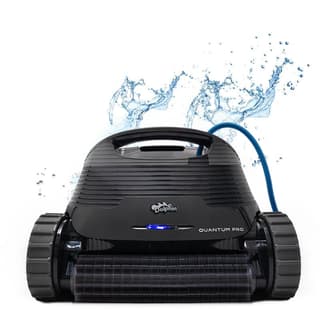
Dolphin Quantum
$1649.00
Vacuums and scrubs the floor, walls, and waterline on a weekly timer, trapping fine debris in an oversized top-load basket — your pump and filter never see any of it.
View Details → Free shipping · 30-day returns
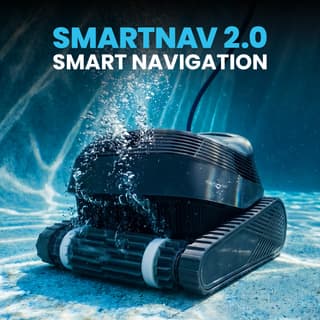
How a robotic pool cleaner vacuums
Under the shell, a robot is doing sophisticated versions of the same steps you just learned. Drive motors move it in systematic lanes — the slow, overlapping passes, automated. A dedicated pump motor pulls water up through intake ports where rotating brushes have loosened stuck-on grime, and everything gets trapped in an onboard basket or cartridge you empty with a hose rinse. Smart navigation maps the pool so it finishes floor, walls, and waterline in about 1.5-3 hours. The full engineering story is in how robotic pool cleaners work.
Which robot replaces your vacuum?
Match the machine to the pool. For inground pools, pick a model that climbs — floor-only cleaning solves half the problem when walls and the waterline collect grime too. Large or complicated layouts with deep ends, benches, and coves reward smarter navigation; our large-pool picks are chosen for exactly that. For above-ground pools, a floor-focused robot is the right tool and costs far less:
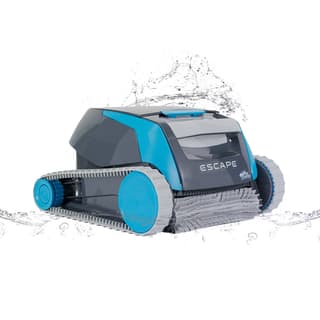
Dolphin Escape
$768.00 $899.00 Save 15%
Commercial-grade motor and aggressive HyperBrush scrubbing for above-ground pools up to 33 feet — it replaces the entire manual vacuum routine for under $700.
View Details → Free shipping · 30-day returns
Keep your manual rig in the shed, though — it still has two jobs. Vacuuming to waste during an algae recovery is a filter-bypassing trick a robot can't replicate, and a two-minute manual pass beats deploying the robot when a planter tips a cup of soil into one corner. For the other fifty weeks a year, let the robot hold the pole.
Your next step
The bottom line
Manual vacuuming is a skill worth having and a chore worth retiring. Brush first, purge the air properly, move slowly from shallow to deep, and watch your filter pressure — that's the whole technique. Then buy the robot, keep the pole in the shed for algae recoveries and one-corner spills, and get your Saturday mornings back.
Now you know how to vacuum a pool the right way — and what it takes to never do it again. If you're ready for the automatic route, our 60-second Help Me Choose quiz matches a robot to your pool's type, size, and debris, or you can browse our top-rated cleaners side by side. Every robot ships free, with 30-day returns and a full manufacturer warranty.
