

Here's our honest answer up front: for most pools, a cordless robotic pool cleaner is not worth the premium. Corded robots win on power, runtime, and long-term value — and they keep winning for more seasons. But cordless has earned a legitimate place in specific situations: detached spas, pools with no outlet in reach, and owners who simply won't deal with a cable. We've tested 70+ robotic pool cleaners on real pools since 2011, including every serious cordless contender, so here is exactly where batteries fall short, where they genuinely shine, and how to tell which side of the cord your pool is on.
Key takeaways
- Corded wins for most pools: constant full power, unlimited runtime, true weekly scheduling, and no battery that fades — usually for less money.
- Cordless is right for some: no outlet within reach, detached spas, rental properties, and owners who know a cable means the robot never gets used.
- Battery reality: expect 60–120 minutes per charge, a multi-hour recharge between cycles, and shrinking capacity after a few seasons of use.
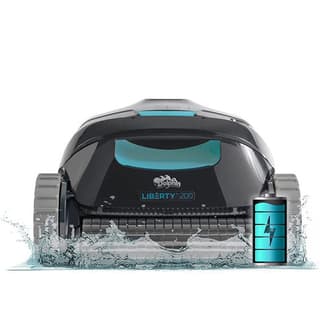
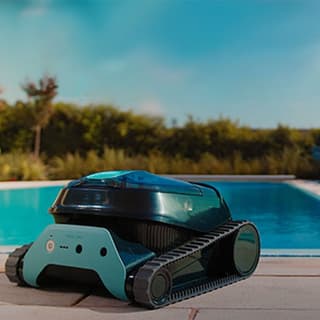
- Our cordless pick: the Dolphin Liberty 200 — Maytronics engineering, floor and wall cleaning for up to 90 minutes per charge, and waterline parking for easy retrieval.
Corded still wins for most pools — here's why
Fifteen summers of side-by-side testing keep producing the same result: put two robots of equal price in the same dirty pool, and the corded one finishes cleaner. It isn't close, and it isn't mysterious. A corded robot draws constant, full-strength power from the wall for as long as the job takes — two hours, three hours, every day of the season if you want. It never fades near the end of a cycle, never makes you wait on a charger, and never loses capacity as it ages.
That's also why corded robots dominate our best robotic pool cleaner rankings year after year. The manufacturer's budget goes into motors and filtration instead of battery packs and charging electronics, and quality swivel cables have mostly retired the tangling problem people remember from old suction hoses. A modern cable is a minor chore, not a curse.
None of that makes cordless pointless — it makes it situational. And if you're in one of those situations, cordless is genuinely the right buy. Let's line the two up honestly.
Corded vs. cordless robotic pool cleaners at a glance
| Factor | Corded robots | Cordless robots |
|---|---|---|
| Runtime | Unlimited — multi-hour cycles, daily if needed | 60–120 minutes per charge |
| Power | Constant full strength, start to finish | Strong, but rationed to protect runtime |
| Scheduling | Weekly timers run cycles unattended | You retrieve and recharge between runs |
| Coverage | Floor, walls, and waterline on flagships | Floor and walls on the best models |
| Aging | No battery — quality units run 5–8+ years | Battery capacity fades after a few seasons |
| Value | More cleaning per dollar | You pay a premium for the battery |
For the deeper head-to-head, see our full corded vs. cordless comparison.
Battery life: what the spec sheet doesn't tell you
Advertised runtime is a best-case figure — a healthy, new battery running a standard cycle. Push a cordless robot up walls or through heavy debris and it draws more current, which shortens the session. In practice, "up to 90 minutes" covers a small or mid-size pool in one pass, but a 35- to 40-foot inground pool with walls often wants a second cycle — and with cordless, that means hours on the charger first. A corded robot just runs again.
The second reality is aging. Lithium batteries are typically good for a few hundred full charge cycles before capacity visibly drops. Run a cordless robot three times a week all season, and by year three to five it's cleaning less pool per charge even though the robot itself is mechanically fine. Corded robots simply don't have this clock ticking inside them.
The third is cadence. Pools stay clean because robots run often — which is why we're such fans of corded models with a weekly timer that run unattended whether you're home or not. A cordless robot keeps you in the loop: retrieve, recharge, redeploy. None of it is hard, but it's one more thing to remember, and the cleanest pools we see are the ones cleaned on autopilot.
Making a battery last: five habits that matter
If you do buy cordless, the battery is the part that decides how many seasons you get. These five habits are what separate a pack that's still strong in year five from one that's tired in year two — and none of them cost anything.
- Don't store it empty. A lithium pack left flat over winter degrades fastest. Charge it to roughly half before it goes into storage, and top it up once mid-winter if the off-season is long.
- Keep it out of the sun. Heat ages cells faster than cycling does. Store the robot shaded and dry rather than parked on hot decking between runs — the same advice we give corded owners, for a different reason.
- Charge it indoors, at room temperature. Charging a hot pack straight out of a summer pool is the worst case. Give it twenty minutes to cool, then put it on the charger.
- Rinse before charging. Salt and chlorine residue on contacts and seals is what eventually lets water where it shouldn't be. A quick freshwater rinse after every cycle handles it.
- Run it regularly rather than rarely. Batteries prefer being used to sitting. A robot that runs twice a week all season ages better than one that runs twice a month.
Power and filtration: where the cord earns its keep
A wall outlet gives engineers a luxury that battery packs never can: an unlimited power budget. That's how corded flagships afford dual or triple motors, aggressive brush speed, and suction that doesn't taper — plus full waterline scrubbing, which takes the kind of sustained grip and power that battery robots have to ration carefully. The money side tells the same story: at the same price as our favorite cordless robot, a corded Dolphin S200 climbs all the way to the waterline and runs on wall power for as many cycles as you like.
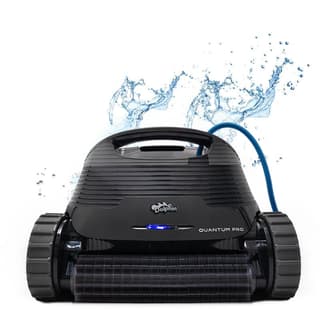
Dolphin Quantum
$1649.00
If a cord doesn't bother you, this is the smarter place for your money: flagship corded cleaning with an XXL top-load fine filter basket, floor-to-waterline coverage, a weekly timer, and no battery to age out.
View Details → Free shipping · 30-day returns
Step up to the Dolphin Quantum and the gap widens further — an XXL fine filter basket, floor-to-waterline coverage, and true set-and-forget scheduling for less than many premium cordless models. When customers ask us whether cordless robots are "as good," this is the honest answer: the best cordless robots are good. Corded robots at the same price are better.
Weight, retrieval, and the price premium
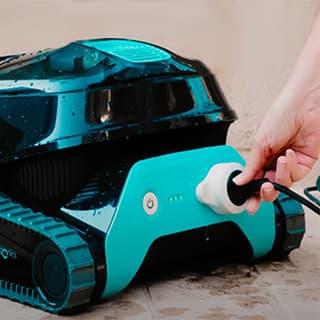
The cordless pitch is convenience, so let's audit the whole routine, not just the drop-in. Deploying a cordless robot really is easier: no cable to unspool, no power supply to position near (but safely away from) the water. Retrieval is where the story can flip. When the battery dies, a robot stops wherever it happens to be — and on some models that means fishing a dead robot off the deep-end floor with a pole. The Liberty 200 solves this neatly by parking itself at the waterline when it finishes, so you lift it out at the pool's edge.
On weight, batteries add pounds, and any robot is heaviest the moment it clears the water. In practice we find the lift comparable between the two types — pause a few seconds at the surface and let the water drain out either way.
Then there's the check you write. Battery cells, charging electronics, and the sealing around them add real cost, so dollar-for-dollar a cordless robot cleans like a cheaper corded one. Whether that premium is worth it depends entirely on whether the cord solves a real problem in your yard — which brings us to the honest case for cordless.
When a cordless robotic pool cleaner is the right call
After all that corded cheerleading, here's the flip side: some pools are simply better served by a cordless robotic pool cleaner, and we tell customers so every week.
- No outlet in reach. Electrical code keeps outlets a healthy distance from the water, and some yards have nothing close. Extension cords and pool equipment should never mix — if power isn't where you need it, cordless solves a real problem.
- Detached spas and plunge pools. Small, separate bodies of water rarely justify running new power. A 90-minute battery covers them with room to spare.
- Rental and second properties. Drop-and-go simplicity that guests can't tangle, kink, or set up wrong.
- Cable-catcher layouts. Center islands, swim-outs, and ladder bases can snag even swivel cables in rare pool shapes.
- The cable-averse. Honestly: the best robot is the one you actually deploy. If you know the cable ritual means the robot stays in the garage, buy the robot you'll use.
What we love
- Zero cable management — drop it in anywhere, no outlet required
- Ideal for detached spas, remote pools, and rentals
- Nothing on the deck to route, shelter, or trip over
- Waterline parking on the Liberty 200 makes retrieval painless
- Simplest possible storage between cleans
What could be better
- Runtime capped at 60–120 minutes, then hours of recharging
- No set-and-forget weekly scheduling
- Battery capacity fades after a few seasons of regular use
- Costs more than corded robots that clean better
- Waterline coverage still trails flagship corded models
Our cordless pick: the Dolphin Liberty 200
Dolphin Liberty 200
$999.00 $1249.00 Save 20%
The cordless robot we actually trust — Maytronics engineering, floor and wall cleaning for up to 90 minutes per charge, and waterline parking so you never fish a dead robot off the pool floor.
View Details → Free shipping · 30-day returns
The cordless market is crowded with brands you've never heard of, and battery-powered robots live or die on engineering quality and long-term support. That's why our pick is the Dolphin Liberty 200 — built by Maytronics, the same company behind every corded Dolphin we sell, with real parts availability and a real warranty standing behind it.
In our testing it does the things that matter: it cleans floors and climbs walls for up to 90 minutes per charge — enough for one full pass of most small and mid-size pools — then parks itself at the waterline for pickup. No cable, no poolside power supply, no drama. If your situation is on the cordless list above, this is the one. You can browse the rest of our cordless collection if you'd like to compare.
The bottom line for your pool
Our verdict
Cordless robotic pool cleaners are worth it for a specific minority of pools — no outlet in reach, a detached spa, a rental, or an owner who knows the cable means the robot never leaves the garage. For everyone else, the same money buys a corded robot that cleans longer, scrubs the waterline harder, schedules itself, and has no battery quietly aging inside it. Be honest about which group you're in, and the answer stops being difficult.
Here's the decision in one breath: if there's a suitable outlet near your pool, buy corded — more power, unlimited runtime, longer life, better value. If power isn't available, if the pool is a detached spa or a rental, or if you know a cable means the robot won't get used, buy the Liberty 200 and don't look back.
Still on the fence? Take our 60-second Help Me Choose quiz and we'll match a robot to your exact pool and situation, or ask our team directly — we've helped more than 10,000 pool owners land on the right side of this exact question. Either way, you get free shipping, 30-day returns, and a full manufacturer warranty.
