Map Your Pool Into Zones Before You Buy
Sketch what the robot will meet. A zone is any body of water the robot can drive around without climbing out. A T-shape is one zone. So is a pool with a peninsula, or a floor that drops from one level to the next. A raised spa, a basin behind a spillway and a pool split by a raised divider are separate zones, and no robot here crosses between them. Then take three numbers:
- Longest straight run of water, to hold against the 33 ft or 50 ft rating.
- Cable path from the power supply to the farthest corner, measured around the peninsula or island, plus the depth there.
- Width of the narrowest channel. Under about 5 ft wide is marginal for every model here.
Set the Cable Up So It Cannot Wrap
Where the power supply sits matters as much as which robot you buy. Place it so the cable reaches every arm without passing around the obstacle: where the two arms meet on a T-shape, or on the bank facing the tip of a peninsula so the cable fans out to both sides. It also has to sit back from the water by the distance in your manual, so count that in the cable path.
An island is the awkward case, because a robot that circles it can lay a full loop of cable around it. If that happens, treat each side as its own job: start the robot on one side with just enough cable in the water to cover it, then repeat on the other.
What a Robot Will Not Do Here
Raised dividers and spillways are walls to a robot, so the far side stays dirty until you carry the machine over. Narrow connecting channels may be skipped, even by a gyroscope model. An irregular pool still needs a brush and a few minutes a week, and no robot replaces your skimmer or sanitizer.
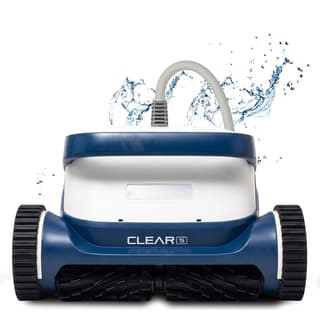
Two robots are missing from the ranking. The Dolphin Escape has a 40 ft cable with no swivel and suits simpler layouts. The Clear UV is the Clear S with a built-in UV-C light controlled from the app, at a higher price.
Running a Robot in an Irregular Pool
- Drop the robot into the largest open area, not beside the peninsula.
- Feed in only as much cable as the farthest corner needs. Spare cable floating near an obstacle is what gets wrapped.
- Watch one whole cycle in the first week, note any arm the robot never enters, and start the next cycle from that spot.
- Brush shallow upper levels, spa seats and the mouths of narrow channels toward open water first, so the robot collects what it cannot reach.