Measure the Legs, Then Do the Cable Arithmetic
Take an L with a 30 ft leg and a 20 ft leg. The longest straight run is 30 ft, and that is the figure a rating is judged on. The legs add up to 50 ft of path, a conservative number to hold against the cable. The power supply has to sit back from the water by the distance in your manual. We use roughly 12 ft here as an example only, so substitute your own figure, and allow a few feet for the cable to drop to the floor. Now compare two positions:
- Power supply at the elbow: about 12 ft of setback, 30 ft to the end of the long leg, plus depth. A 55 ft cable covers it. A 50 ft cable is at its limit.
- Power supply at the end of the long leg: 12 ft of setback, 30 ft to the corner, then close to 20 ft more. That is beyond every cable on this page.
Why the Inside Corner Catches Cables
The inside corner is the one place in an L where the cable gets pulled against a hard edge. When the robot is in one leg and the cable enters from the other, the cable bends around that corner and drags on it each time the robot moves. A twisted cable is stiffer and forms loops, and a loop is what hooks.
If the robot keeps stopping short in the far leg, look at the corner first. Three fixes, in this order: move the power supply to the elbow, put less cable in the water, and take the twists out by laying the cable straight in the sun.
True L, Lazy L and What No Robot Does
A true L turns 90 degrees. A lazy L bends at a wider angle, so its inside corner is gentler and cables hang on it less often. In either, the top step or two will not be reached by any robot, so brush them toward the floor before a cycle.
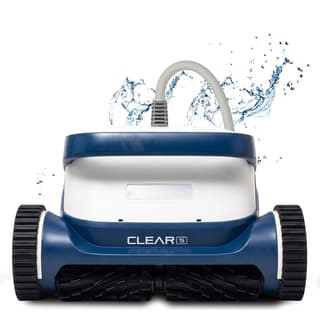
Two robots we sell are not picks. The Dolphin Escape has a 40 ft cable, also without a swivel, which runs out in all but the smallest L. As for the Clear UV, it is a Clear S with an app-controlled UV-C light built in and a higher price.
Setting Up in an L-Shaped Pool
- Stand the power supply near the elbow, back from the edge by the distance in your manual, even if that means using a different outlet.
- Lower the robot into the longer leg and let the cable feed out as it goes.
- On the first run, look in after an hour. If the robot has not visited the second leg, start the next cycle there.
- With a cable that has no swivel, unplug it after several cycles and walk it out straight across the deck.