Put the Power Supply Where the Deep End Is
Most owners plug the robot in near the house, usually the shallow end, which leaves the deepest, dirtiest part of the pool at the very end of the cable. Move the power supply toward the deep end, or at least to the middle of a long side.
An example, taking roughly 12 ft as the distance the power supply must sit back from the water (use the figure in your own manual): in a 40 ft pool with an 8 ft deep end, a power supply at the shallow end needs 12 ft to the edge, 40 ft along the pool and 8 ft down. That is 60 ft, more than any cable here. Placed at the deep end of a 16 ft wide pool, the same robot needs about 36 ft.
Robot Always Parked in the Deep End? It Is Rarely a Fault
A robot found at the bottom of the deep end after every cycle is usually explained by one of these.
- A full filter. A robot packed with leaves moves less water, and less flow means less grip on the slope. Empty it and run again before assuming a fault.
- A twisted cable. Kinks shorten the cable and hold the robot back. Unplug it from the power supply, lay it straight on the deck and work the twists out, especially on a cable without a swivel.
- Where the cycle ended. A robot that spends much of its cycle in the deep end will often be there when time runs out.
What a Robot Will Not Do for a Deep End
A robot collects what has sunk. It does not skim, so today's floating leaves are tomorrow's deep-end pile unless the skimmer or a net gets them first. It does not replace sanitizer or brushing either: dark patches that smear are algae and need treatment, with the robot out of the water before you shock. And it is not a shovel. If a thick mat of leaves is sitting on the bottom, scoop the bulk out with a leaf rake first, then let the robot finish.
Deep-End Setup Tips That Cost Nothing
- Put only as much cable in the water as it takes to reach the far deep-end corner; keep the rest on the deck where it cannot tangle.
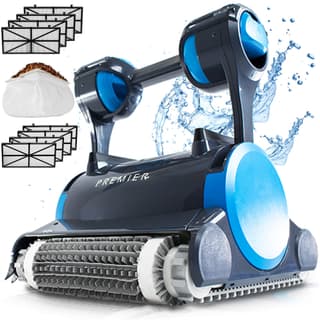
- In leaf season fit the Premier's leaf bag, or the standard or coarse panels on a basket robot, then return to fine media once silt is the issue.
- After a storm, run two cycles and empty the filter between them. The first takes the top of the pile, the second what was underneath.