The floor of an above-ground pool is only as flat as the sand under it. Three features decide how cleanly a robot covers it.
- Footprints and divots: soft spots become shallow bowls where fine debris gathers. A light robot rides through most of them, but deep heel marks can hold dirt below the brush. They are fixed from under the liner, usually at the next liner change.
- Wrinkles: a low ripple is no obstacle. A tall, sharp fold can stop a robot or steer it away, leaving a strip untouched behind it. Smooth wrinkles out while the water is warm and the liner is supple, before you blame the robot.
- The cove: the curved wedge of sand or foam where floor meets wall. It is where a robot tips up to climb, and where leaves and silt settle. Watch the first cycle to see how the robot takes it, and brush the cove by hand if a line of dirt is left.
Checking Cable Reach on Round and Oval Pools
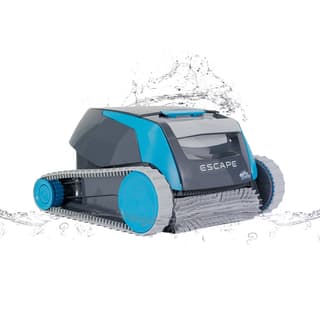
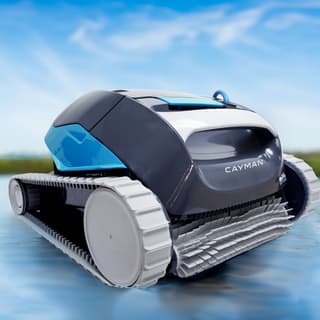
Both robots are rated to 33 ft, but their cables differ: 40 ft on the Escape and 50 ft on the Cayman. Reach is the setback of the power supply from the water, plus the distance across the pool to the far wall, plus the water depth. Use the setback in your manual; roughly 12 ft is a typical example, not a published figure.
On that example, with 4 ft of water, an 18 ft round pool needs about 34 ft of cable and a 24 ft round pool about 40 ft, which is the Escape's whole cable. A 15 x 30 oval needs about 37 ft from the middle of a long side and about 46 ft from one end. Past roughly 24 ft across, the position of the power supply or a longer cable decides it.
What a Robot Does Not Replace on an Above-Ground Pool
A robot picks up what has sunk and scrubs the floor and walls. It does not skim the surface, so the skimmer and pump still do that job, and it does not sanitize, so your usual sanitizer stays on the same routine. Neither robot here cleans the waterline, so the scum line at the top of the liner is a quick wipe by hand. Take the ladder or steps out before a cycle if you can, because the legs are an easy place for a robot or its cable to get caught.
Setting Up a Robot in an Above-Ground Vinyl Pool
- Walk the floor barefoot first and pick up anything sharp, such as stones or twigs, that a robot could drag across the liner.
- Set the power supply on the side nearest an outlet, at the distance your manual gives, and check the cable reaches the far wall.
- Lower the robot in by its handle and let it sink and settle before you start it. Do not drop it onto the liner.
- Lift it out over the top rail by the handle, let the water drain back into the pool, then empty the basket.
- With the Escape, which has no timer as standard, make starting a cycle part of a fixed routine, such as every other morning.