Best Robotic Pool Cleaner for Lazy Rivers: The Honest Answer and the Nearest Fits

A lazy river is a long loop with a current, not a pool, so we explain what a pool robot can do in a small backyard one and where it stops.

3 ranked picks Find the right clean without paying for features you won’t use
The quick answer

Which Robot Should You Buy?

Treat this as a workaround, not a match. For a small backyard river with the current off, the closest fit is the Dolphin Quantum: a swivel cable, a 2-hour cycle and the lightest body of the three to carry between sections. The Dolphin Premier is the alternative when leaves are the main debris. For a resort or community river, call us before buying anything.

Before you buy

None of the robots on this page is designed for a lazy river. They are pool cleaners rated for pools up to 50 ft, and a river is a long, narrow loop with moving water. The picks below are the closest fits for a small backyard river, cleaned in sections with the current off. Resort-scale rivers need commercial equipment.

On this page: the picks · side by side · questions · our advice

We would rather be straight about this. The best robotic pool cleaner for lazy rivers does not exist among residential robots, because each one here is rated for a pool up to 50 ft long, and a lazy river is a narrow loop that can run to hundreds of feet with water moving through it. A 55 ft cable reaches only part of that loop.

A small backyard river is a different matter. With the current off, a channel wide and deep enough for the robot to turn, and a plan to clean one section at a time, a good pool robot does useful work. This page ranks the three nearest fits, the Quantum, the Premier and the Dolphin Sigma, and sets out the method. If yours is a resort or community river, call us instead.

The Three Nearest Fits, Ranked for the Section Method

In order, with today’s price on each.

Top Choice
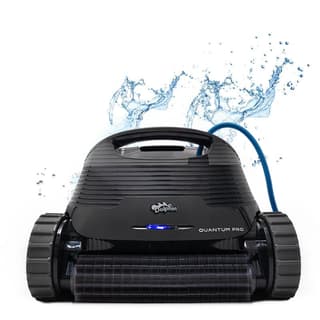
Dolphin Quantum Robotic Pool Cleaner
$1599
Maytronics

Dolphin Quantum

Closest Fit: Lightest of the Three, Shortest Cycle

Nothing here is made for a river, so we ranked by what the section method demands. The Quantum is the lightest of the three at 18.3 lb, which you will notice by the third lift, and its 2-hour cycle is the shortest, so four sections take eight hours of run time where a 3-hour robot takes twelve. The 55 ft cable has an anti-tangle swivel. Its basket loads from the top and opens with one click, quick to empty between sections, and its published coverage names stairs and sun shelves, which many rivers have at the entry. It is also the lowest-priced of the three, a sensible cap on spending when the job is outside the design.

Best for
Backyard rivers with a channel floor wider than about 5 ft, cleaned a section at a time.
Keep in mind
A 2-year warranty. No rating describes a river, so treat the coverage as best effort.
No. 2
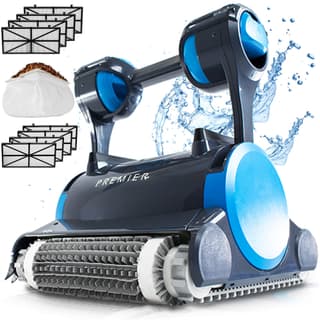
Dolphin Premier Robotic Pool Cleaner with Multi-Media, Oversized Leaf Bag, & 3 Year Warranty
$1949 $2499 Save $550
Maytronics

Dolphin Premier

Nearest Fit for Leafy Rivers

Rivers wind through planting, and when leaves are the main debris the Premier is the better tool. Its Multi-Media system includes an oversized leaf bag as well as NanoFilters and standard fine filters, so you can fit the bag for the river and keep the fine media for the pool it joins. The 55 ft cable has a 360-degree swivel, and dual ProLine motors move 4,500 GPH. It is second for two practical reasons: at 20.3 lb it is heavier to carry between positions, and its 3-hour cycle makes each section a longer wait. It carries a 3-year warranty.

Best for
Rivers under trees or palms, and owners who want one robot for the river and the main pool.
Keep in mind
No app, 20.3 lb to carry, and three hours for every section.
No. 3
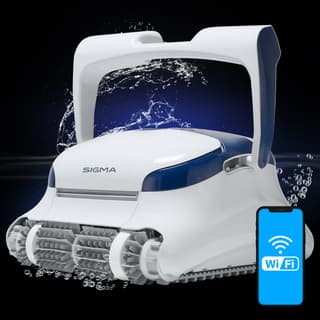
Dolphin Sigma Robotic Pool Cleaner with Gyroscope, Wi-Fi, Oversized Filters, & 3 Year Warranty
$2349 $2999 Save $650
Maytronics

Dolphin Sigma

Steadiest Heading Through Curves, Heaviest Dolphin to Carry

On navigation alone the Sigma would be first. SmartNav 3.0 with an onboard gyroscope helps it hold a heading in a channel that never runs straight, and its quad brushes scrub the two walls that make up so much of a river's surface. The cable is 55 ft with a 360-degree swivel, and the cycle is 2.5 hours. It is third because the section method works against it: at 24.6 lb it is the heaviest of the three to lift in and out, and it carries the highest price for a job no robot here was designed to do.

Best for
Owners whose main pool justifies a Sigma, with a short river attached.
Keep in mind
Heaviest and highest-priced of the three. An app schedule cannot move the power supply for you.

What Makes a River Different From a Pool

  1. The Current Has to Be Off

    Pool robots are built for still water. A river's flow pushes a robot off its path and drags its cable downstream. Shut the river pump down before every cycle and give the debris time to settle to the floor.

  2. Room to Turn

    The robot has to turn around inside the channel. Under about 5 ft of floor width, the fit becomes marginal for any model here. The water must also be deep enough to keep the robot submerged, and the manual gives that minimum for each model.

  3. A Swivel Cable Is Essential

    A river is all curves, so the robot turns constantly and the cable twists with it. All three picks have a swivel that lets the twist run out. A swivel cannot stop the cable looping around the island, though. Only limiting the cable does that.

  4. Sections, Not Laps

    A 55 ft cable, less the setback from the edge and the depth, reaches only so far each way. The river is cleaned as a chain of sections, each one its own cycle from its own power supply position.

  5. Lifting and Carrying

    You will lift the robot out, carry it and the power supply to the next position and lower it in again, several times per clean. Weight matters more here than in any pool.

The Three Robots Compared

Specification Dolphin Quantum Dolphin Premier Dolphin Sigma
Price today $1599 $1949 $2349
Navigation SmartNav 2.0 SmartNav 2.0 SmartNav 3.0 with gyroscope
Cable 55 ft with anti-tangle swivel 55 ft with 360° anti-tangle swivel 55 ft with 360° anti-tangle swivel
Pool length Up to 50 ft Up to 50 ft Up to 50 ft
Cleans Floor, walls, waterline, sun shelves and stairs Floor, walls and waterline Floor, walls and waterline
Cycle time 2 hours 3 hours 2.5 hours
Scheduling Weekly timer: every day, every 2 days or every 3 days Weekly timer: every day, every 2 days or every 3 days Weekly scheduler by day and time
Warranty 2 years 3 years 3 years
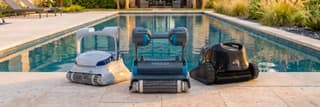
Three robotic pool cleaners on the deck of a rectangular inground pool
Straight walls are the easy case. Curves, coves and corners are where cable handling and navigation matter.

How to Clean a Backyard River in Sections

Think of the river as a row of short pools. Each section gets one cycle, then you move everything along. The cable defines the section: the robot wanders as far as the cable lets it in either direction, so the length you feed into the water is your control.

Count the sections before you buy. Four sections at two hours each is a full day of run time, so it makes sense to clean half the river one day and half the next.

  • Walk the loop and mark where the power supply can stand, back from the edge by the distance in your manual, with an outlet in reach.
  • Space the marks so each section is well inside the 50 ft rating. Shorter sections come out cleaner.
  • Feed in only enough cable to reach the ends of that section. Extra cable lets the robot travel on around the bend, and around the island.
  • When the cycle ends, lift the robot out, empty the filter, and carry the robot and power supply to the next mark.

Is Your Channel Wide and Deep Enough?

Measure the channel at its narrowest point, wall to wall at the floor, not at the waterline where a curved wall flares out. Once the floor is under about 5 ft across, the fit is marginal for all three picks.

Then check depth along the whole loop. Rivers are often shallower than pools, and some have humps, benches or a beach entry. A robot must stay submerged to hold suction, so compare the minimum in your model's manual with your shallowest stretch. Bridges, tunnels and tight inside bends deserve a look too, because they are where a cable snags. Any part that fails these checks is a part you brush and vacuum by hand.

Where Residential Robots Stop

A resort, hotel or community lazy river is beyond every robot on this page: too long, open too many hours a day, and built on a scale a 55 ft cable cannot serve. Those rivers are cleaned with commercial machines. Tell us the length, width and depth and we will point you in the right direction. In any river, a robot works alongside the filtration and sanitizer and replaces neither.

Other robots we sell fit even less well. The Clear S and Clear UV have a 59 ft anti-tangle cable, but their working depth starts at 2.5 ft, which a shallow channel may not meet. The Dolphin Cayman is rated to 33 ft, and the Dolphin Escape has a 40 ft cable. Neither has a swivel, which rules both out here.

A Section-by-Section Routine

  1. Turn the river pump off and wait for the water to go still before the robot goes in.
  2. Net out floating leaves first, so they do not sink into a section you have already cleaned.
  3. Clean the sections in order around the loop, so you always know which ones are done.
  4. Rinse the filter between sections, not only at the end. A loaded filter cuts suction for the next stretch.
  5. Keep the current off until the robot and its cable are out of the water.

Lazy River Questions

Can a robotic pool cleaner run in a lazy river with the current on?

No. These robots are designed for still pool water. Moving water pushes the robot off course, pulls on the cable and carries debris past the intake before it can be collected. Turn the river pump off, let the water settle, and run the cycle. Switch the current back on only after the robot and cable are out.

How many sections will my lazy river need?

Measure the loop down the middle of the channel and divide it into stretches comfortably under 50 ft. A 150 ft loop, for example, works out to four sections of under 40 ft, and four cycles. Outlets, bridges and the setback distance in your manual usually decide where the positions fall.

Will the cable wrap around the island?

It can, if the robot is free to travel the whole loop. A swivel lets twists spin out of the cable, but it cannot undo a full turn around the island. The fix is to put only as much cable in the water as one section needs, so the robot runs out of slack before it gets around the bend.

What do resorts and water parks use to clean lazy rivers?

Commercial cleaning equipment built for long runs and daily use, alongside the river's own filtration and manual vacuuming. None of the residential robots on this page is rated for that work. If you manage a commercial river, contact our team with its dimensions and we will tell you plainly whether we can help.

The Verdict

A Workaround, Not a Perfect Match

Our advice: buy a robot for a lazy river only if the river is small, the current can be switched off, the channel floor is wider than about 5 ft, and you accept cleaning it in sections. If all four are true, the Quantum is the closest fit, the Premier suits leafy rivers and the Sigma makes sense when a demanding main pool shares it. If any is false, keep your money and talk to us about commercial options first.

Our top choice

Dolphin Quantum

Closest Fit: Lightest of the Three, Shortest Cycle

$1599

Need Help Choosing?

Tell us about your pool and what keeps landing in it. Five quick answers are enough to narrow hundreds of options to a handful worth buying.

5Quick Questions
60Seconds
ZeroGuesswork